
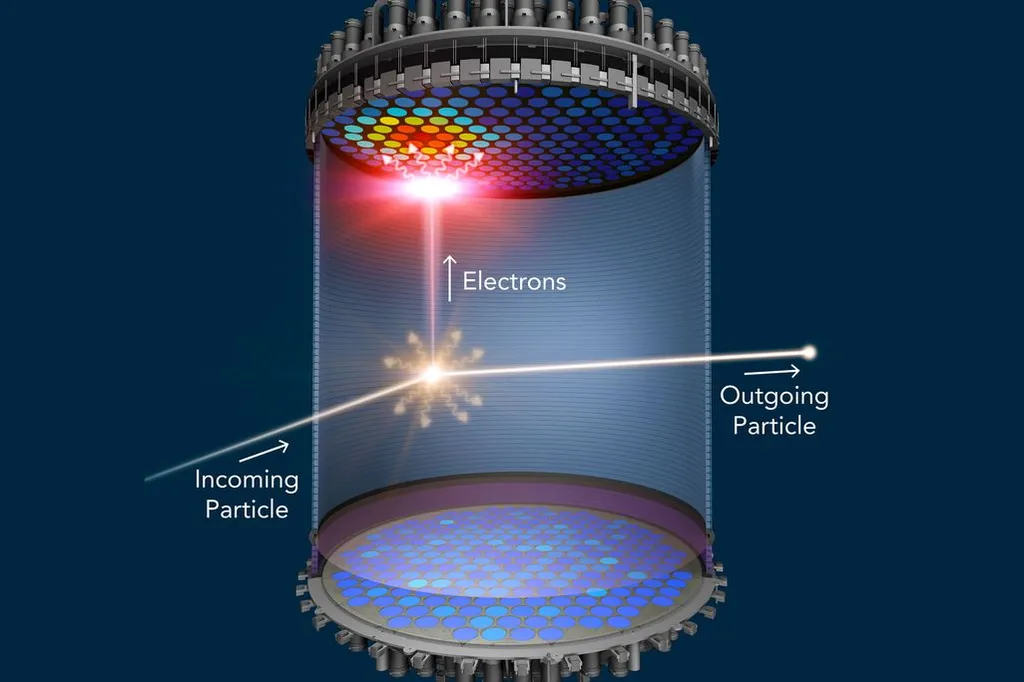
Researchers T. E. Bikbaev, M. Yu. Khlopov, and A. G. Mayorov from the National Research Nuclear University MEPhI in Moscow have proposed a new theoretical approach to understanding dark matter interactions, which could have implications for the energy sector, particularly in nuclear energy applications. Their work was published in the journal Physical Review D.
The researchers focus on a hypothesis that suggests dark matter particles could form composite structures called “dark atoms,” specifically a combination of a dark matter particle and a helium nucleus, denoted as $XHe$. These dark atoms are neutral and atom-like, making them difficult to detect using conventional methods. The challenge lies in understanding how these dark atoms interact with the nuclei of ordinary matter, as the unshielded nuclear attraction could potentially destabilize the dark atom’s bound state.
To tackle this issue, the researchers developed a novel numerical quantum mechanical approach that accounts for the complex interplay between electromagnetic and nuclear forces. This method simplifies the inherently complex three-body system involving the dark atom and the nucleus, where analytical solutions are not feasible. By reconstructing the effective interaction potential, they identified key features such as a dipole Coulomb barrier and a shallow potential well. These features can lead to the formation of bound states between the dark atom and the nucleus, influencing low-energy capture processes.
The model proposed by the researchers provides a robust framework for interpreting experimental anomalies, such as the annual modulation signals observed in the DAMA/LIBRA experiment. This work advances the theoretical understanding of dark matter interactions and offers a foundation for designing future experiments to detect dark matter more effectively.
For the energy sector, particularly nuclear energy, this research could contribute to a better understanding of nuclear processes and interactions at the fundamental level. This could potentially lead to improved nuclear reactor designs, enhanced safety measures, and more efficient energy production methods. However, it’s important to note that this research is still in its theoretical stages, and practical applications may be far off. The findings highlight the importance of continued investment in fundamental research, as it can lead to unexpected breakthroughs with significant practical implications.
This article is based on research available at arXiv.