
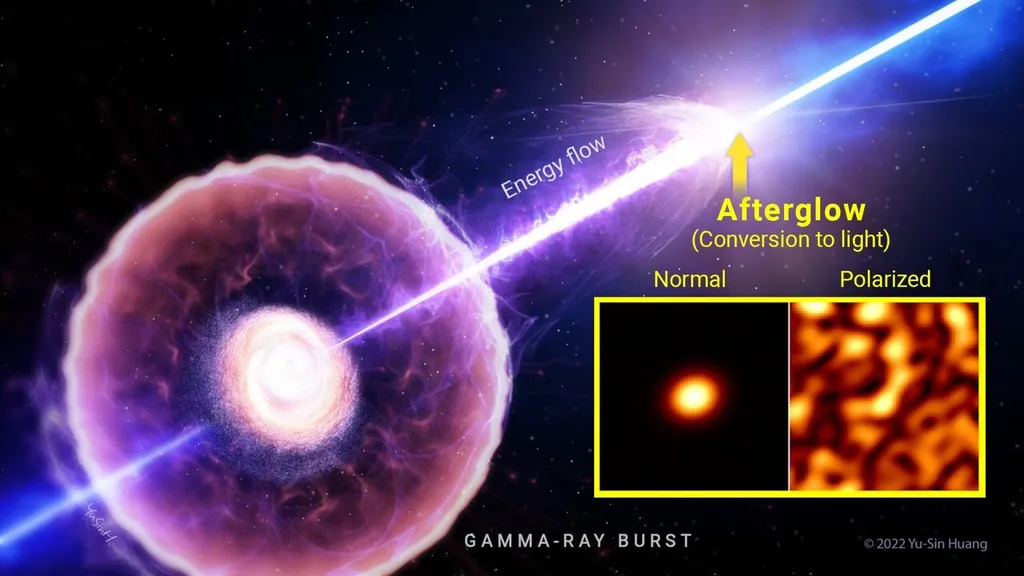
In the realm of astrophysics and energy research, understanding the environments surrounding cosmic events like gamma-ray bursts (GRBs) can provide valuable insights into the fundamental processes driving these phenomena. Dr. Xiao-Hong Zhao, a researcher at the Institute of High Energy Physics, Chinese Academy of Sciences, has delved into the intricate details of GRB afterglows to unravel the mysteries of their dense circumburst environments.
Gamma-ray bursts are among the most energetic events in the universe, and they are typically believed to occur in environments with either a uniform interstellar medium or a dense stellar wind from a massive progenitor. However, recent observations of GRB 191019A have suggested that some GRBs might originate within the accretion disks of active galactic nuclei (AGNs), which are extremely dense environments. This hypothesis, though still debated, has sparked considerable interest because AGN disks could potentially host progenitors of both long and short GRBs. The dense, gas-rich environment of AGN disks could significantly influence the propagation of jets and the emission of afterglows, which are the fading emissions observed after the initial burst.
In a study published in the Astrophysical Journal, Dr. Zhao investigates how multi-wavelength afterglow light curves can serve as diagnostic tools to probe the nature of the circumburst environment. The research reveals that in dense environments, GRB afterglows exhibit distinct frequency-dependent behaviors. For jets with large opening angles, the X-ray light curve shows a shallow decay or bump due to a transition from synchrotron to synchrotron self-Compton (SSC) dominance. Synchrotron radiation is the emission of electromagnetic radiation by charged particles moving at relativistic speeds in a magnetic field, while SSC is a process where the same electrons that produce synchrotron radiation scatter these photons to higher energies. Meanwhile, the optical and high-energy (GeV) light curves follow typical power-law decays.
On the other hand, for jets with small opening angles, the light curves exhibit wavelength-dependent jet breaks. The GeV and optical bands break simultaneously, while the X-ray break is delayed as the SSC component gradually compensates for the fading synchrotron component. These distinct signatures provide potential diagnostics for identifying GRBs occurring in dense media such as AGN disks.
The practical applications of this research for the energy sector are indirect but significant. Understanding the environments and mechanisms behind GRBs can enhance our knowledge of high-energy astrophysical processes, which in turn can inform the development of advanced energy technologies. For instance, insights into the behavior of relativistic jets and the interaction of high-energy particles with magnetic fields can contribute to the design of more efficient particle accelerators and other energy-related technologies. Additionally, the study of extreme astrophysical environments can inspire innovations in energy production and management, as scientists and engineers seek to harness the principles governing these cosmic phenomena for practical applications on Earth.
In summary, Dr. Zhao’s research sheds light on the complex interplay between GRBs and their dense circumburst environments, offering valuable diagnostic tools for astrophysicists and potential insights for the energy sector. As our understanding of these cosmic events continues to grow, so too does our ability to apply this knowledge to the development of cutting-edge energy technologies.
This article is based on research available at arXiv.