
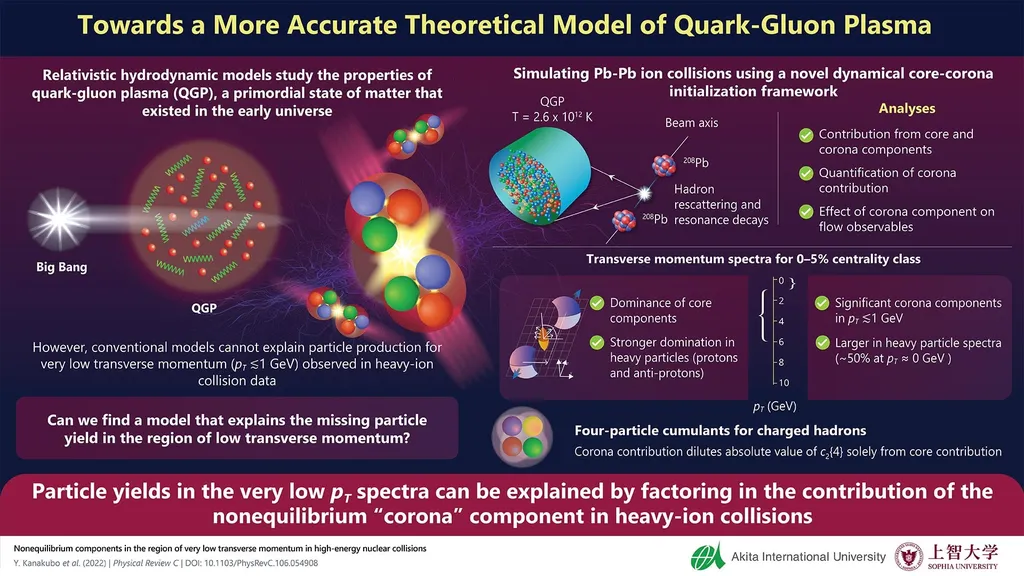
In the realm of high-energy physics, a team of researchers from Central China Normal University, including Xu-Fei Xue, Zi-Xuan Xu, Wei Dai, Jiaxing Zhao, and Ben-Wei Zhang, has made significant strides in understanding the behavior of particles in the quark-gluon plasma (QGP), a state of matter that existed just after the Big Bang. Their work, published in the journal Physical Review Letters, focuses on the transport properties of heavy quarks and jets within the QGP, which has implications for understanding energy dissipation in extreme environments.
The researchers employed a sophisticated Bayesian inference approach to analyze data from lead-lead (Pb-Pb) collisions at the Large Hadron Collider (LHC). Specifically, they looked at the nuclear modification factor and elliptic flow of D-mesons, which are particles containing heavy quarks. By using a unified Langevin transport model that accounts for both collisional and radiative energy loss, the team was able to constrain the temperature-dependent spatial diffusion coefficient of heavy quarks and the scaled jet transport coefficient.
The study found that the centrality of the collisions—meaning how head-on the collisions were—played a significant role in the constraints on these parameters. Data from collisions with 30-50% centrality provided stronger constraints than those with 0-10% centrality. This suggests that the transport properties of the QGP can be more precisely determined from certain types of collisions.
One of the key findings was the temperature dependence of the ratio between the quark jet transport coefficient and the heavy-quark diffusion coefficient. This ratio was found to deviate from the previously estimated value of 2, spanning a range of 0.25 to 0.8. This insight offers a deeper understanding of the interplay between these fundamental transport properties in the strongly coupled medium of the QGP.
For the energy sector, this research provides a foundation for understanding energy dissipation mechanisms in extreme environments, which could have implications for the development of advanced energy technologies. The methods used in this study could also be applied to other areas of energy research, such as the study of plasma behavior in fusion reactors or the behavior of particles in high-energy environments relevant to nuclear energy.
In summary, this work establishes a data-driven quantitative relationship between heavy-quark dissipation and jet transport properties in the quark-gluon plasma. It offers crucial insights into their interplay in the strongly coupled medium, which could have broader implications for understanding energy dissipation in various contexts.
This article is based on research available at arXiv.