
Researchers Konstantin Köster and Payam Kaghazchi from the University of Münster have published a study that delves into the phase-transition dynamics of layered-oxide sodium-ion cathode materials. Their work, titled “Computational Studies on O2-P2 Phase-Transition Dynamics in Layered-Oxide Sodium-Ion Cathode Materials,” was published in the Journal of Physical Chemistry C.
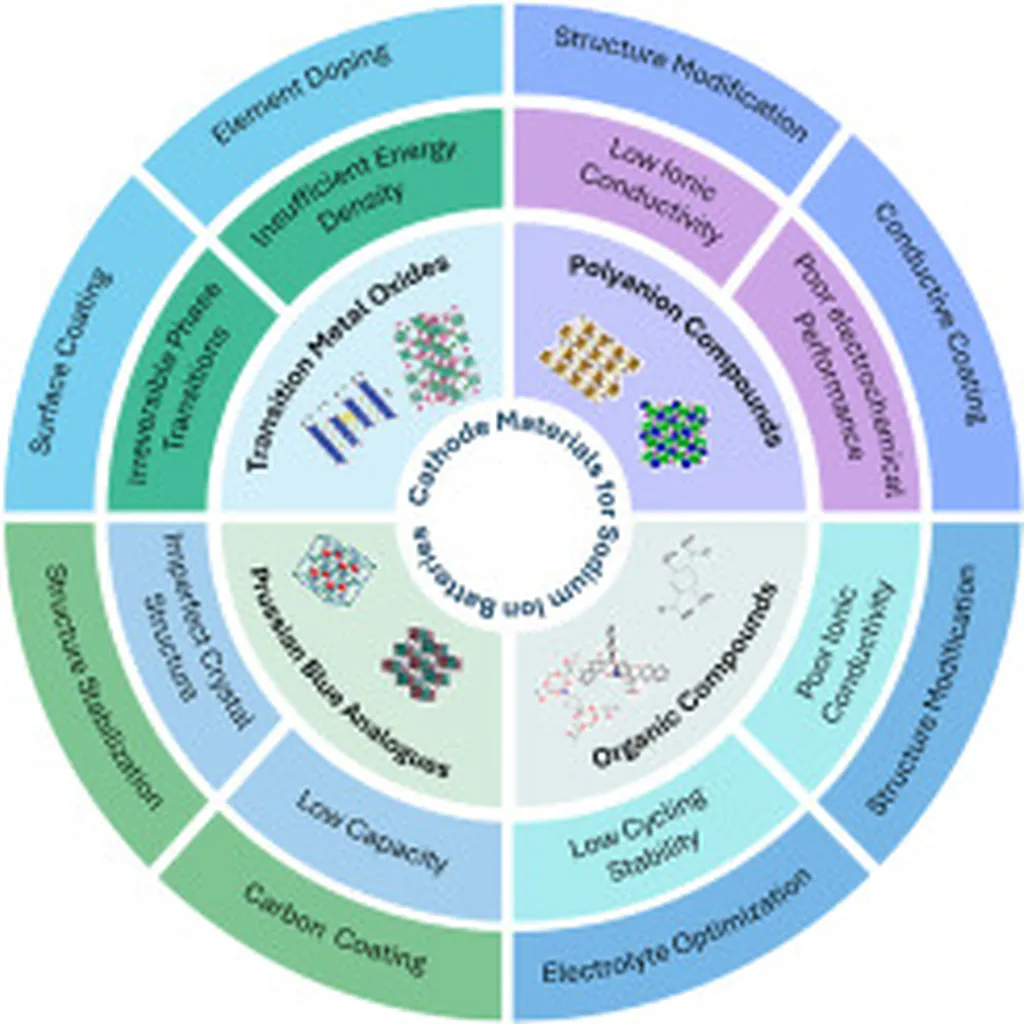
Sodium-ion batteries are gaining traction as a promising alternative to lithium-ion batteries, particularly for large-scale energy storage. Layered oxides are a strong contender for cathodes in these batteries, but they face challenges such as capacity degradation and voltage fading. These issues are largely influenced by phase transitions that occur during battery operation, where layers within the material glide, affecting performance. However, understanding these transitions at the atomic level has been difficult due to the complex computations required.
To tackle this, Köster and Kaghazchi developed a classical pairwise Coulomb-Buckingham potential, trained using extensive ab initio data and a genetic algorithm. This potential was used to study the O2-P2 phase transitions in Na_xCoO_2. Their density functional theory (DFT) and classical potential calculations revealed that the barriers to phase transitions decrease as sodium is removed from the material (desodiation) and are further lowered under dynamic conditions, as simulated through molecular dynamics.
The researchers found that the phase transition occurs gradually through various intermediate phases, labeled OPn. Importantly, their developed potential could capture these phase transitions and the associated increase in sodium-ion diffusivity under standard laboratory conditions. This was achieved at the microsecond timescale of molecular dynamics simulation, a significant advancement given the computational demands of such studies.
The practical implications for the energy sector are notable. By understanding these phase transitions better, researchers can work towards mitigating capacity degradation and voltage fading in sodium-ion batteries. This could enhance the performance and longevity of these batteries, making them more viable for large-scale energy storage applications. The study provides a crucial step forward in the atomistic-level understanding of these materials, paving the way for improved battery technologies.
This article is based on research available at arXiv.