
Researchers Qi-Yin Lin, Guang-Zheng Ye, Can Li, Wan-Jun Su, and Huai-Zhi Wu from the University of Science and Technology of China have proposed a novel approach to enhance the charging power of quantum batteries. Their work, published in the journal Physical Review Letters, focuses on nonreciprocal quantum batteries within non-Hermitian systems, which can overcome intrinsic dissipation and reverse flow constraints.
Quantum batteries are a cutting-edge area of research that aims to harness quantum mechanical effects to create more efficient energy storage devices. The researchers propose a design that includes a charger and a battery, which are coherently coupled and interact with an auxiliary “bad cavity.” This setup leverages environmental dissipation to suppress reverse energy transfer, a common issue in quantum battery systems.
Under resonant conditions, the researchers achieved a fourfold ratio of battery energy to charger energy. This ratio significantly decreases under large detuning, indicating the importance of precise tuning for optimal performance. By optimizing damping, the team attained high efficiency in short-time charging power, making the system more practical for real-world applications.
The study also found that quantum batteries operating at the exceptional point (EP) exhibit greater resilience to parameter fluctuations compared to fully nonreciprocal schemes. This resilience is crucial for the stability and reliability of energy storage systems. The findings highlight the potential of non-Hermitian quantum engineering to advance quantum battery technology, particularly in areas involving directional energy transfer, controlled dissipation, and entropy management in open quantum systems.
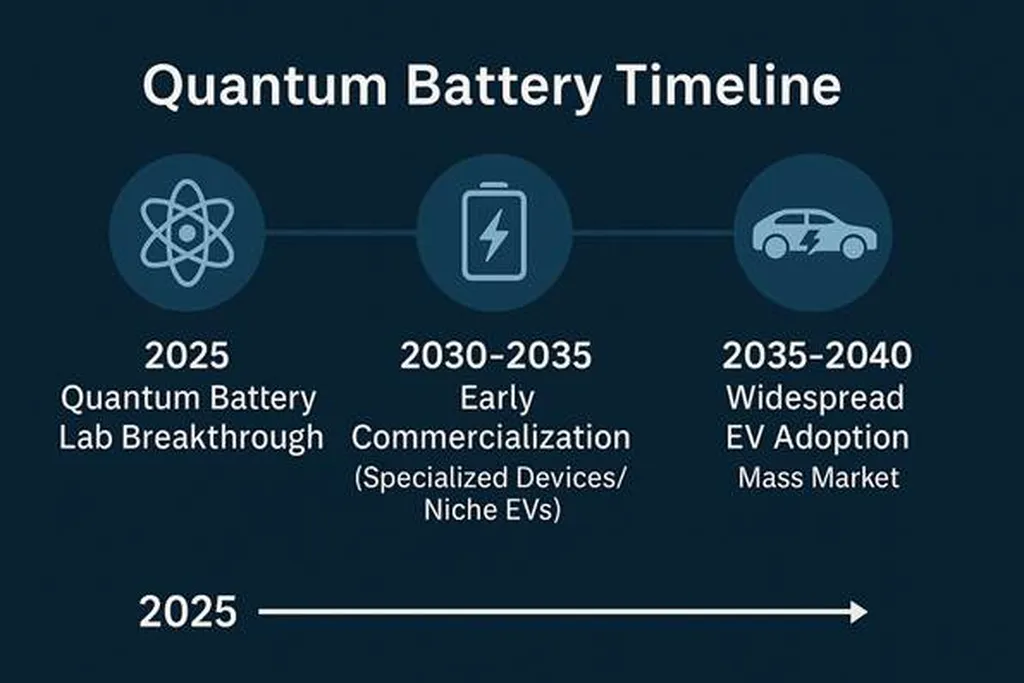
For the energy sector, this research could lead to more efficient and stable quantum batteries, which could revolutionize energy storage solutions. Quantum batteries could potentially store energy more densely and release it more quickly than conventional batteries, making them ideal for applications requiring high power output in short bursts, such as electric vehicles or renewable energy grids. The ability to control dissipation and manage entropy could also improve the longevity and reliability of these energy storage devices, making them more viable for widespread use.
In summary, the researchers have demonstrated a novel approach to enhancing the performance of quantum batteries by leveraging non-Hermitian systems and reservoir engineering. Their findings could pave the way for more efficient and stable energy storage solutions, with significant implications for the energy industry. The research was published in Physical Review Letters, a prestigious journal in the field of physics.
This article is based on research available at arXiv.