
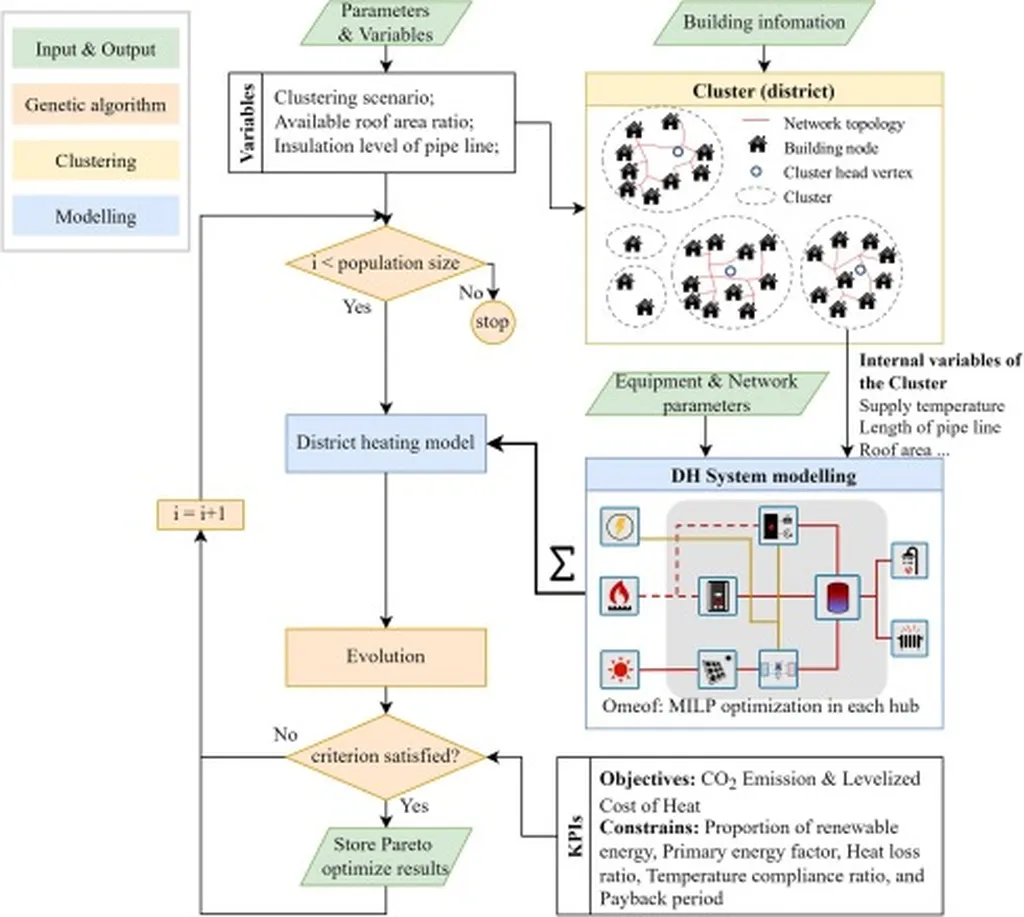
Patrik Schönfeldt and Elif Turhan, researchers at the University of Bremen’s Institute for Integrated Energy Systems, have published a study in the journal Energy and Buildings that explores a new approach to optimizing heat supply in municipal districts. Their work aims to address the computational challenges posed by the large number of buildings involved in district heating planning.
When planning heat supply for municipalities, energy system models must consider hundreds or thousands of buildings, leading to a significant increase in computational complexity. To manage this, planners often aggregate input data by grouping buildings based on geographical or urban formations. However, Schönfeldt and Turhan propose incorporating energy performance indicators into this grouping process to improve the accuracy and efficiency of energy system optimization.
The researchers used authentic data from the Neu-Schwachhausen district in Bremen, grouping buildings based on geographical location, building geometry, and energy performance indicators. They considered annual heat consumption and solar energy generation potential, developing a methodology that accounts for both the anticipated annual energy quantity and its progression over time. This approach allows for a more nuanced understanding of energy demand and supply dynamics.
The study presents a comprehensive workflow from geodata to a set of techno-socio-economically Pareto-optimal heat supply options. The findings suggest that balancing geographical position and energy properties when grouping buildings can lead to more effective energy system models. This approach could help municipal planners optimize heat supply systems, reduce energy consumption, and integrate renewable energy sources more effectively.
In practical terms, this research could assist energy providers and municipal planners in designing more efficient district heating systems. By incorporating energy performance indicators into the grouping process, they can better account for variations in energy demand and supply, leading to more accurate models and improved decision-making. This could ultimately result in more sustainable and cost-effective heat supply solutions for communities.
The research was published in the journal Energy and Buildings, providing a valuable contribution to the field of energy system optimization and municipal heat planning.
This article is based on research available at arXiv.