
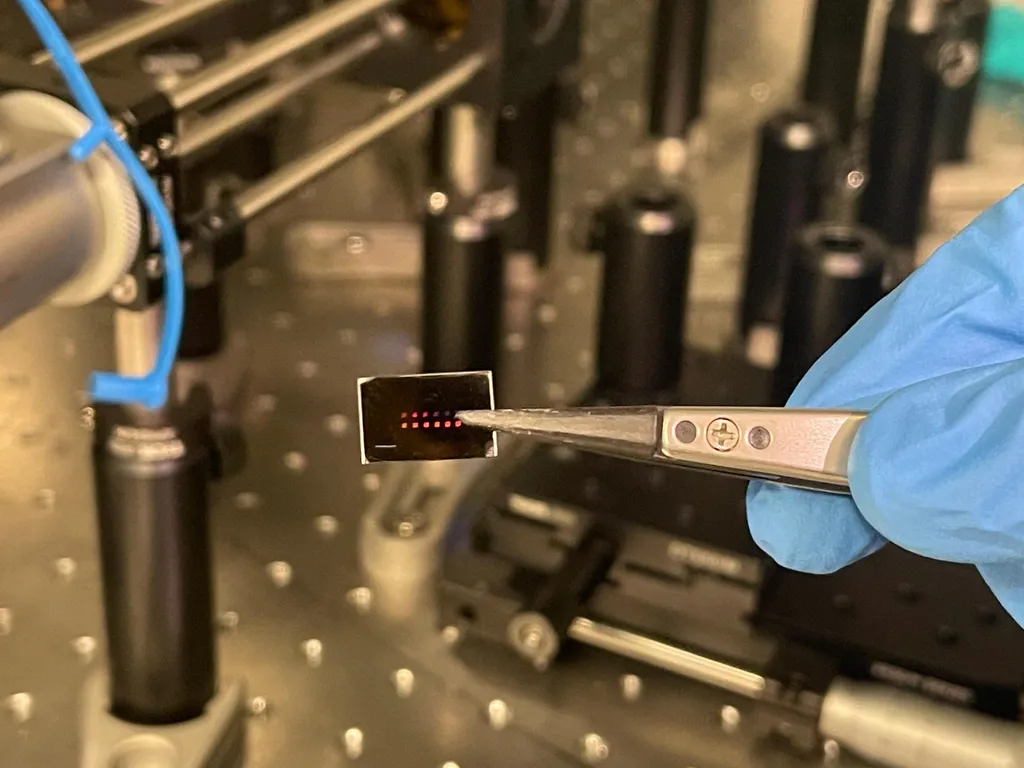
In the realm of energy and materials science, researchers Shraman Kumar Saha and Philippe Guyot-Sionnest from the University of Chicago have been exploring the potential of III-V colloidal quantum dots, particularly Indium Arsenide (InAs) and its composites with Indium Phosphide (InP) and Zinc Selenide (ZnSe). Their recent study, published in the journal “Advanced Materials,” delves into the mid-infrared intraband transitions of these quantum dots, opening up new possibilities for the energy sector.
Colloidal quantum dots are tiny semiconductor particles that have been widely studied for their applications in detectors and emitters, ranging from visible light to short-wave infrared. However, their use in the mid-infrared spectrum has been limited due to challenges in stable n-doping, a process that introduces free electrons into the material. This study aims to overcome this hurdle, focusing on InAs, InAs/InP, and InAs/ZnSe quantum dots with an energy gap at 1.4 microns.
The researchers employed electrochemistry to investigate the quantum dot films, revealing state-resolved mobility, state-resolved electron filling, and intraband absorption in the 3-8 micron range. They found that InAs/ZnSe films required a more reducing potential than InAs, while InAs/InP films needed a lower reduction potential. Notably, dry films of InAs/InP dots demonstrated stable n-doping of the 1Se state, with steady-state intraband absorption in the 3-5 micron range and intraband luminescence at 5 microns.
The practical applications of this research for the energy sector are significant. Mid-infrared technology is crucial for various energy-related applications, including gas sensing, thermal imaging, and free-space communication. The stable n-doping achieved in this study could lead to more efficient and reliable mid-infrared detectors and emitters, enhancing these technologies. Moreover, the low toxicity, high thermal stability, and stable n-doping of InAs quantum dots make them an attractive material for these applications.
In conclusion, this research represents a significant step forward in the development of mid-infrared technologies, with potential benefits for the energy industry. As the study authors note, the stable n-doping of InAs quantum dots opens up new avenues for their use in mid-infrared applications, bringing us closer to more efficient and reliable energy technologies.
This article is based on research available at arXiv.