
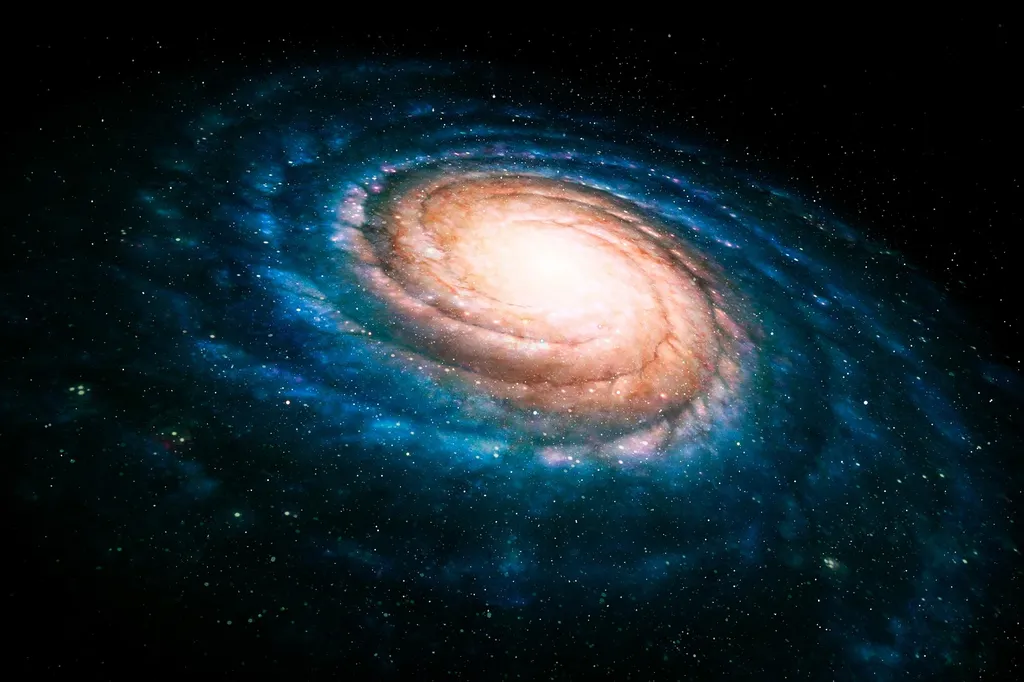
In a recent study, a team of researchers led by A. C. Gormaz-Matamala from the University of Geneva, along with collaborators from the Czech Academy of Sciences, has revisited the evolutionary status of massive stars located at the central parsec of the Milky Way. Their findings, published in the journal Astronomy & Astrophysics, have significant implications for understanding the dynamics of the Galactic Centre (GC) and the accretion processes onto the supermassive black hole Sgr A*.
Massive stars and their powerful winds play a crucial role in shaping the environment of the GC. The winds from these stars collide and are eventually accreted onto Sgr A*, with the accretion rate influenced by the chemical composition of the stars. The researchers aimed to update the evolutionary models of these massive stars using revised mass-loss rate recipes, which describe how stars lose mass over time.
Using the Geneva-evolution-code, the team simulated the evolution of stars with initial masses ranging from 20 to 60 times the mass of the Sun, adopting a metallicity typical of the GC. They incorporated new mass-loss rate prescriptions for different types of stars, including O-type stars, B-supergiants, and red supergiants (RSG). The simulations also considered initial rotation rates and the Ledoux criterion for convection in the inner layers of the stars.
The updated models predicted that stars would retain more of their outer layers during their initial phases, with significant mass loss occurring primarily during the RSG phase. This led to Wolf-Rayet (WR) stars that are less radially homogeneous in their inner structure. Notably, the new models suggested the absence of hydrogen-free WN stars, aligning better with observed chemical abundances of WR stars at the GC.
The researchers provided a table of chemical abundances for different subtypes of WR stars, proposing a re-arrangement of these subtypes for better modeling of wind collisions. These changes could have important implications for understanding the dynamics of colliding winds from massive stars and their accretion onto Sgr A*.
The study highlights the importance of accurate mass-loss rate prescriptions in evolutionary models of massive stars. For the energy sector, understanding the life cycles and chemical evolution of massive stars can provide insights into the distribution of heavy elements in the universe, which are crucial for various energy-related processes, including nuclear fusion and the formation of planetary systems. Additionally, the dynamics of the GC and the behavior of Sgr A* can offer valuable lessons for understanding the behavior of other supermassive black holes, which are thought to play a role in the evolution of galaxies and the large-scale structure of the universe.
This article is based on research available at arXiv.