
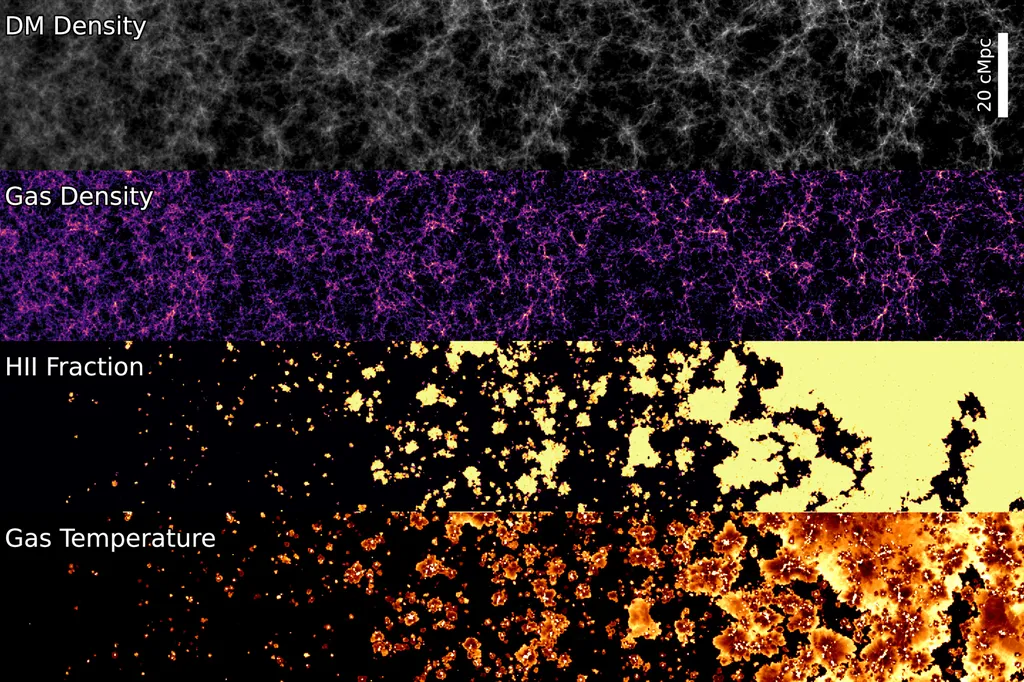
In the realm of energy journalism, it’s crucial to stay informed about cutting-edge scientific research that could potentially impact the energy sector. A recent study titled “The THESAN project: Lyman-alpha intensity mapping of cosmic reionization” offers intriguing insights into the early universe, which might have implications for our understanding of energy distribution and cosmic evolution.
The research was conducted by a team of scientists including Mouza Almualla, Aaron Smith, Rahul Kannan, Lars Hernquist, Enrico Garaldi, Adam Lidz, Kevin Lorinc, Jennifer Yik Ham Chan, and Mark Vogelsberger, who are affiliated with various institutions such as the Center for Astrophysics | Harvard & Smithsonian, the Massachusetts Institute of Technology, and the University of California, Irvine.
The study focuses on Line Intensity Mapping (LIM), a powerful cosmological probe that aims to map the large-scale structure of the universe during the Epoch of Reionization (EoR). The EoR is a significant period in cosmic history when the first stars and galaxies ionized the intergalactic medium, transforming it from a neutral hydrogen fog into the ionized plasma we observe today. Understanding this process is crucial for comprehending the evolution of the universe and the distribution of energy within it.
The researchers leveraged the state-of-the-art THESAN cosmological simulations to produce high-resolution theoretical predictions for future Lyman-alpha LIM studies. They constructed continuous light cones for line-of-sight cosmological integrations and assessed the contributions of various factors, such as recombination, collisional excitation, and unresolved HII regions, to the total Lyman-alpha spectral intensity. Additionally, they explored the intergalactic medium in absorption at different redshifts using damping wing analysis.
One of the key findings of the study is that the slope of the absorption-included Lyman-alpha fluctuation power spectrum at smaller scales steepens toward lower redshift. The researchers also found that their emission-only Lyman-alpha power spectrum lies above the SPHEREx sensitivity, a next-generation instrument designed to map the evolution of large-scale structure during the EoR. However, the absorption-included signal is approximately four orders of magnitude lower, providing a conservative lower limit on inhomogeneity signatures and highlighting the importance of including resonant scattering in future models.
The study also identified limitations in the current analysis and proposed next steps, including incorporating the effects of resonant Lyman-alpha scattering and line interlopers, as well as utilizing larger simulation volumes. These advancements could further refine our understanding of the EoR and its implications for the energy sector.
The research was published in the Monthly Notices of the Royal Astronomical Society, a leading journal in the field of astronomy and astrophysics. While the direct practical applications for the energy industry may not be immediately apparent, understanding the fundamental processes that shaped the universe can provide valuable insights into the distribution and evolution of energy on cosmic scales. This knowledge could potentially inform the development of new technologies and strategies for harnessing and managing energy resources more effectively.
In conclusion, the THESAN project offers a fascinating glimpse into the early universe and the processes that shaped its evolution. As we continue to explore the cosmos, we may uncover new insights that could revolutionize our approach to energy production, distribution, and consumption. Stay tuned for further developments in this exciting field of research.
This article is based on research available at arXiv.