
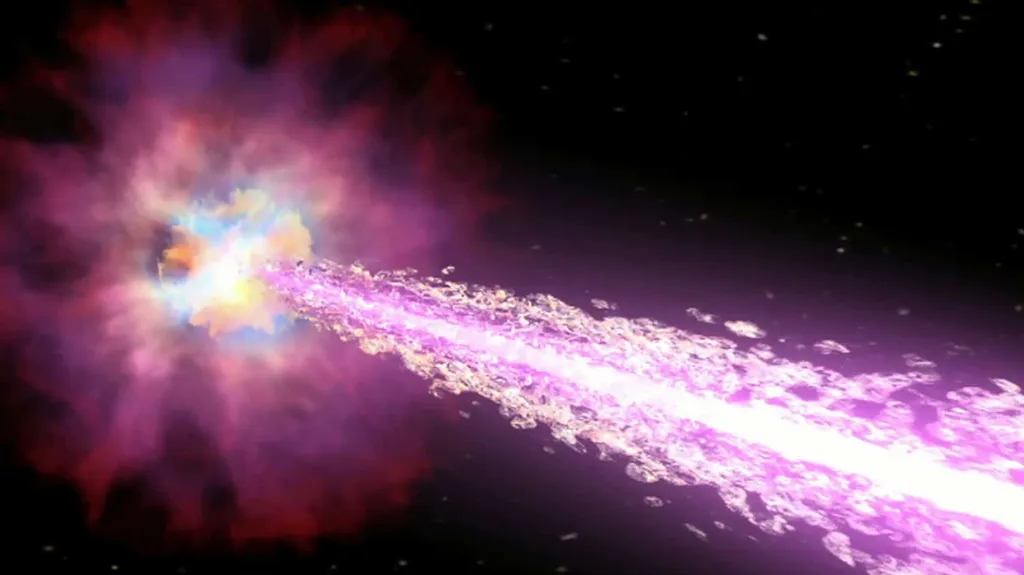
In the realm of astrophysics and energy research, a team of scientists from various institutions, including the University of Leicester, Tel Aviv University, and the Kavli Institute for Particle Astrophysics and Cosmology, has been delving into the mysteries of gamma-ray bursts (GRBs). These researchers, led by H. Dereli-Bégué, have recently published their findings in the Monthly Notices of the Royal Astronomical Society, shedding light on the origins of flares observed in GRB afterglows.
Gamma-ray bursts are intense explosions that release a tremendous amount of energy in the form of gamma rays. They are among the most energetic events in the universe, and understanding their behavior can provide valuable insights into the fundamental processes that govern the cosmos. One of the key features of GRBs is their X-ray light curves, which exhibit complex temporal structures such as flares and plateaus. The origin of these flares has been a subject of debate among scientists.
In their study, the researchers analyzed a sample of 89 GRBs, 61 of which exhibited flares. They examined both GRBs with and without a “plateau” phase, fitting the Swift-XRT light curves with synchrotron emission models. Their analysis revealed that the flare light curves are not symmetric, with a decay time that is approximately five times longer than the rise time. Importantly, they found no differences in flare properties between GRBs with and without a plateau phase. Additionally, other afterglow properties, such as the electron power-law index and the end time of the plateau, were consistent between bursts with and without flares.
These findings strongly suggest that flares originate from a mechanism distinct from that producing the plateau and afterglow. When examining the prompt emission properties, the researchers noted that GRBs with flares tend to be brighter and longer-lasting than those without flares. This observation leads them to conclude that flares are more plausibly associated with prolonged central engine activity that lasts longer than the main episode producing the prompt phase. Consequently, the study rules out models of late-time energy injection as the source of the GRB plateau.
For the energy sector, understanding the mechanisms behind gamma-ray bursts and their afterglows can have practical applications. For instance, the intense energy release in GRBs can serve as a natural laboratory for studying high-energy physics and the behavior of matter under extreme conditions. This knowledge can inform the development of advanced energy technologies and contribute to our understanding of energy production and transfer in the universe. Furthermore, the study of GRBs can enhance our ability to detect and analyze high-energy events, which can be crucial for monitoring and mitigating the impact of such events on space-based infrastructure and Earth’s atmosphere.
In summary, the research conducted by Dereli-Bégué and her colleagues provides valuable insights into the origins of flares in gamma-ray bursts, highlighting the distinct mechanisms behind flares and plateaus. This work not only advances our understanding of these cosmic phenomena but also offers potential benefits for the energy sector by deepening our knowledge of high-energy processes and their applications.
This article is based on research available at arXiv.