
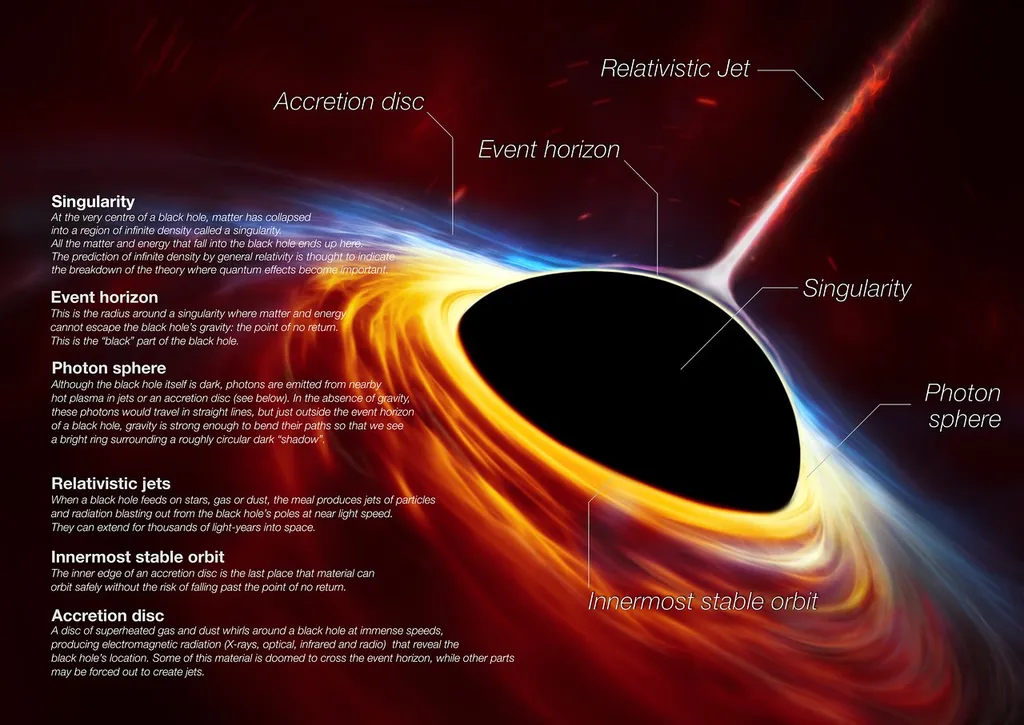
Researchers Valerio De Luca, Brandon Khek, Justin Khoury, and Mark Trodden from the University of Pennsylvania have published a study exploring the intriguing similarities between black holes in general relativity and supersonic acoustic flows. Their work, titled “Hidden symmetries for tidal Love numbers: generalities and applications to analogue black holes,” was published in the journal Physical Review D.
Tidal Love numbers are a measure of how compact objects, such as stars or black holes, deform in response to external tidal forces. Interestingly, these numbers are zero for black holes in four-dimensional general relativity, a phenomenon attributed to hidden symmetries governing perturbations in these spacetime environments. The researchers have found that a similar vanishing of certain tidal Love numbers occurs in supersonic acoustic flows, which share key features with black holes, including an effective acoustic horizon and a wave equation describing linear excitations.
The study demonstrates that the symmetries observed in acoustic black holes can be traced back to the structural properties of the underlying wave equation. This finding mirrors the symmetries found in general relativistic black hole spacetimes. By exploring this connection, the researchers aim to deepen our understanding of the fundamental physics governing both black holes and analogue systems.
While the direct practical applications to the energy sector may not be immediately apparent, the insights gained from this research could contribute to a broader understanding of wave dynamics and symmetries in complex systems. This could potentially inform the development of advanced materials or technologies that harness similar principles, such as improved acoustic insulation or novel approaches to energy transmission. The research was published in Physical Review D, a peer-reviewed journal covering topics in theoretical and particle physics.
This article is based on research available at arXiv.