
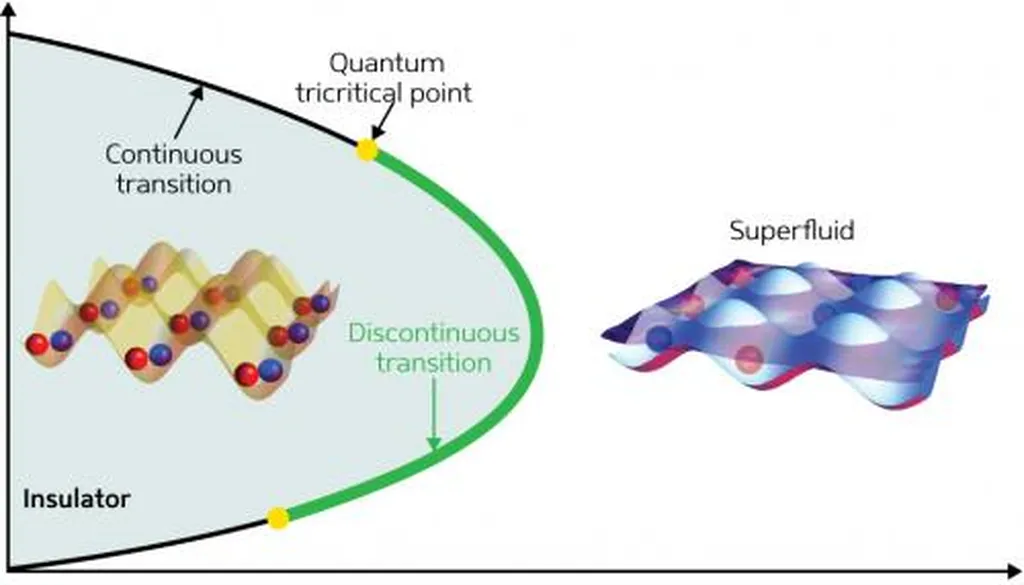
Researchers from the School of Physical Science and Technology at ShanghaiTech University, including Yue-Peng Wang, Zi-Qiang Zhao, Hui Zeng, and Zhang-Yu Nie, have recently published a study in the journal Physical Review D that investigates phase transitions in a holographic p-wave superfluid model. The team’s findings could have implications for understanding and controlling phase transitions in various energy-related materials and technologies.
The study focuses on a specific type of superfluid model, known as a p-wave superfluid, which incorporates nonlinear terms of 4th and 6th order with coefficients λ and τ. The researchers demonstrated that these nonlinear terms can universally control the phase transitions of the p-wave model, similar to what has been observed in holographic s-wave cases. By analyzing the behavior of the condensate and free energy across typical phase transitions, the team was able to map out the λ-τ parameter space that characterizes different types of transitions, including 2nd, 1st, and 0th order.
For a slightly negative λ, the researchers established a τ-ρ phase diagram featuring a line of first-order phase transition points that terminates at a critical point. Beyond this critical point lies a supercritical region. The results confirm that the p-wave superfluid phase transitions can be precisely tuned through the coefficients λ and τ. The comprehensive phase diagrams and quantitative transition criteria provided in the study offer a valuable resource for future research in this area.
In the context of the energy industry, understanding and controlling phase transitions is crucial for developing advanced materials and technologies. For instance, phase transitions play a significant role in the performance of superconductors, which are materials that can conduct electricity without resistance. Superconductors have the potential to revolutionize the energy sector by enabling more efficient power transmission and storage systems. The findings of this study could contribute to the development of new superconducting materials with tunable phase transition properties, ultimately leading to more efficient and reliable energy technologies.
Furthermore, the study’s focus on p-wave superfluids is particularly relevant to the energy industry, as p-wave superconductivity has been observed in certain materials, such as strontium ruthenate. Understanding the phase transitions in these materials could lead to the development of new energy storage and conversion technologies. Overall, the research conducted by the team at ShanghaiTech University provides valuable insights into the control of phase transitions in superfluid models, which could have significant implications for the energy industry.
This article is based on research available at arXiv.