
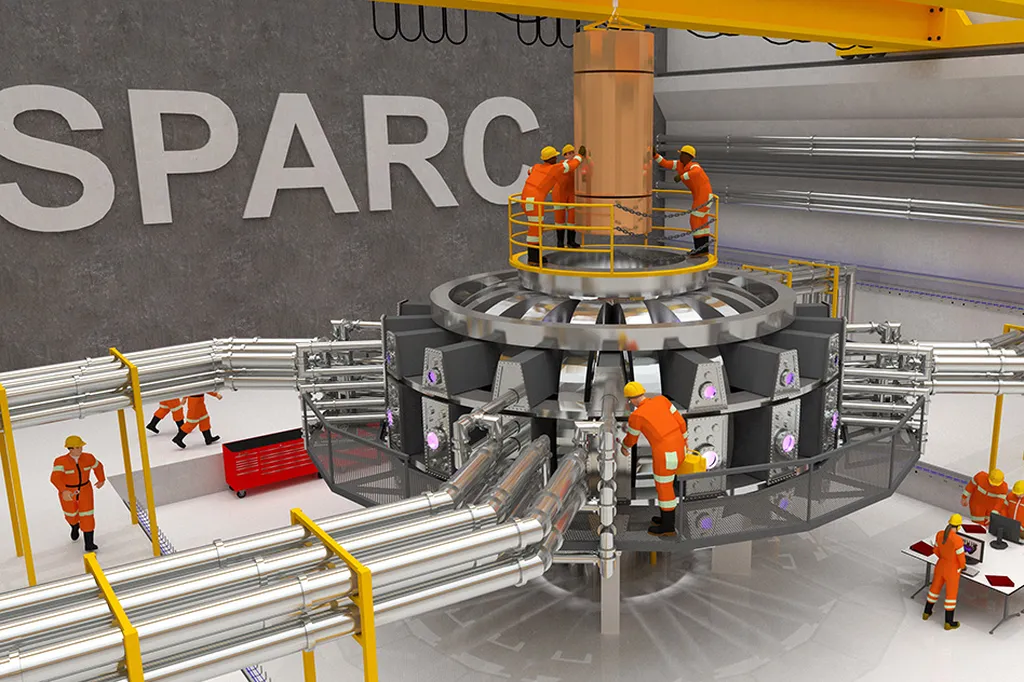
Researchers from the Massachusetts Institute of Technology’s Plasma Science and Fusion Center have delved into the complex interactions between magnetohydrodynamic (MHD) instabilities and runaway electrons (REs) during disruptions in tokamak reactors, with a focus on the SPARC tokamak. The team, led by Rishabh Datta and including Christopher Clauser, Nicholas Ferraro, Ryan Sweeney, and Robert A. Tinguely, has published their findings in a recent study.
The researchers used the M3D-C1 code, an extended MHD code with a runaway electron fluid model, to investigate these interactions. Their goal was to better understand and predict RE generation and to design effective mitigation strategies, such as massive gas injection (MGI). The SPARC tokamak, a high-field, high-current device designed to achieve a fusion gain greater than 1, serves as the backdrop for their simulations.
The team explored various scenarios, including different combinations of neon (Ne) and deuterium (D2) injection. Their results highlighted several key effects that arise from the self-consistent coupling of REs and MHD. For instance, they observed an initial increase in RE generation due to the growth of MHD instabilities. Additionally, they noted a decrease in the saturation energies of the m/n = 1/1 mode, which drives sawteeth-like activity, and RE losses in stochastic magnetic fields. Interestingly, they also found that RE confinement and plateau formation can occur due to the re-healing of flux surfaces.
The simulations revealed that large RE plateaus, exceeding 5 megaamperes (MA), can be obtained with neon-only injection. However, combined D2 and Ne injection resulted in a lower RE current, less than 2 MA. In cases where D2 and Ne were injected together, a post-thermal quench “cold” vertical displacement event (VDE) terminated the RE beam, preventing a steady plateau.
This research represents a significant step forward in understanding RE generation and mitigation in high-current devices like SPARC. The findings are crucial for the design and operation of future fusion reactors, as they provide insights into how to manage and mitigate runaway electrons during disruptions. The study was published in the journal Nuclear Fusion.
This article is based on research available at arXiv.