
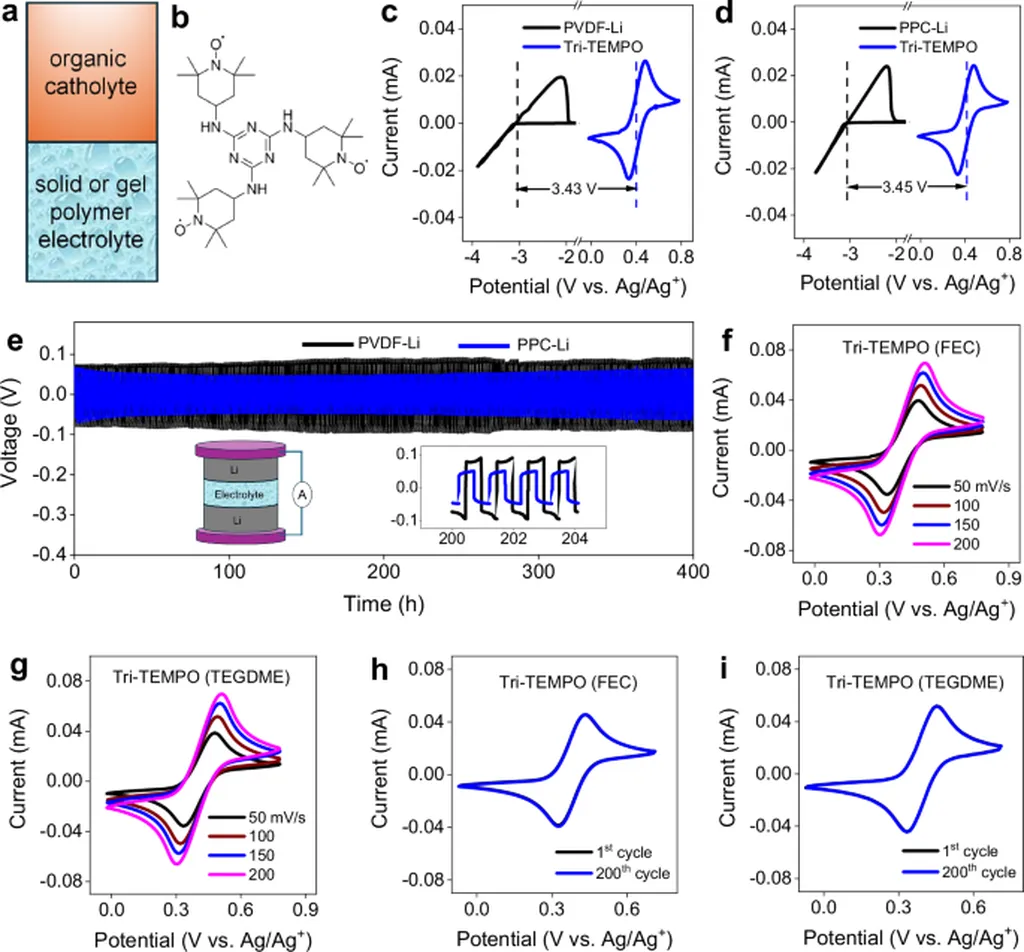
A team of researchers has successfully demonstrated a scalable, high-efficiency lithium-sulfur (Li-S) redox flow battery that operates without a membrane, marking a significant leap forward for grid-scale energy storage. Published this week in ACS Applied Energy Materials, the breakthrough combines redox-targeting with a robust solid electrolyte interphase (SEI), enabling a hybrid flow battery architecture that safely separates the lithium anode from solid sulfur in a catholyte reservoir. This innovation addresses long-standing challenges of safety, scalability, and cost that have hindered the commercialization of Li-S batteries for large-scale applications.
The new design leverages redox mediators—electrochemically active molecules—to facilitate the reduction of solid sulfur into soluble polysulfides and, ultimately, lithium sulfide. By eliminating the need for a membrane, the system avoids the inefficiencies and costs associated with traditional flow battery architectures, where crossover of active materials can degrade performance and increase electrolyte waste. The researchers achieved high sulfur utilization in static cells and validated the process using electrochemical and spectroscopic methods, confirming the stability and efficiency of the Li-S chemistry in a flow environment.
“By integrating redox mediation with a membrane-less design, we’ve overcome the primary barriers to scaling Li-S flow batteries,” explained the lead researcher. “This approach not only simplifies manufacturing but also unlocks the potential for ultrahigh energy density and low-cost storage, which is critical for integrating renewable energy into the grid.” The theoretical energy density of Li-S chemistry is 3-5 times higher than that of conventional lithium-ion batteries, and the use of abundant, low-cost sulfur further enhances its economic viability.
The implications for energy sustainability are profound. As grids increasingly rely on intermittent renewable sources, the need for cost-effective, long-duration storage solutions has never been more urgent. Traditional lithium-ion systems, while dominant, face limitations in scalability and resource dependency. Flow batteries, particularly those using Li-S chemistry, offer a compelling alternative: they can be sized flexibly, exhibit long cycle life, and avoid the safety risks associated with flammable electrolytes. This breakthrough could accelerate the deployment of grid-scale storage, supporting the transition to a more resilient and decarbonized energy infrastructure.
Industry observers note that while further optimization is needed—particularly in cycling stability and system integration—the membrane-free Li-S flow battery represents a transformative step. “This is the kind of innovation that could redefine how we store energy at scale,” said an independent energy storage analyst. “If these results translate to commercial systems, we could see a new standard for grid storage within the decade.”.