
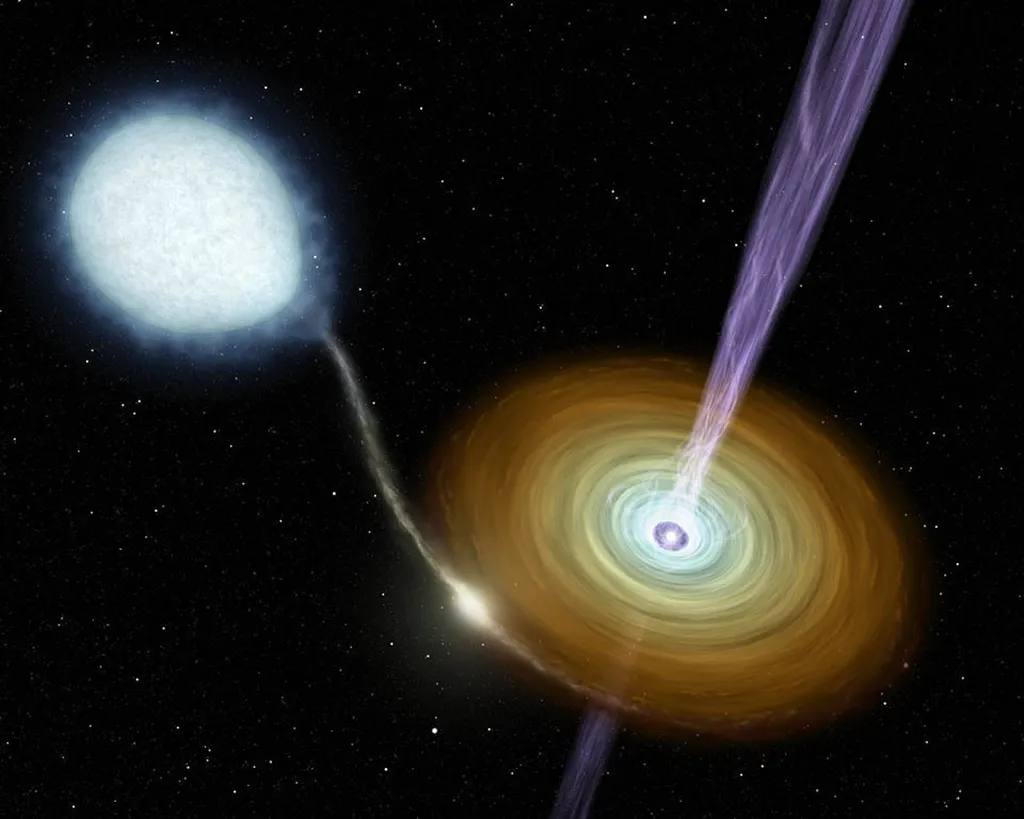
Researchers from the University of Nevada Las Vegas, led by Yacheng Kang and including Jin-Ping Zhu, Lijing Shao, Jiahang Zhong, Jinghao Zhang, and Bing Zhang, have recently published a study in the Astrophysical Journal that explores the unique characteristics of white dwarf-neutron star (WD-NS) merger events. Their findings could have implications for understanding certain transient astronomical phenomena and potentially even the energy sector.
The study focuses on the unstable mass transfer that occurs during WD-NS mergers, where the white dwarf can be tidally disrupted and form an accretion disk around the neutron star. This process produces unbound wind ejecta, which includes synthesized nickel-56 (56Ni). The researchers found that this ejecta is strongly polar-dominated, meaning it is not evenly distributed in all directions. This asymmetry causes the resulting radioactive-powered thermal transient to be viewing-angle-dependent, a phenomenon that has not been extensively investigated until now.
Using numerical simulations and a semi-analytical discretization scheme, the team simulated the observed viewing-angle-dependent photospheric evolution, as well as the resulting spectra and lightcurves. They discovered that the observed photosphere evolves over time and is strongly influenced by the viewing angle. Off-axis observers can see deeper, hotter inner layers of the ejecta and larger projected photospheric areas compared to on-axis observers.
For a typical WD-NS merger producing 0.3 solar masses of ejecta and 0.01 solar masses of synthesized 56Ni, the resulting peak optical absolute magnitudes of the transient span from approximately -12 magnitudes along the polar direction to -16 magnitudes along the equatorial direction. This corresponds to luminosities of 10^40 to 10^42 erg per second. The typical peak timescales are expected to be between 3 to 10 days.
The researchers propose using the term “mini-supernovae” to describe the thermal emission following WD-NS mergers, as their ejecta composition and energy sources resemble those of supernovae, but they are dimmer and evolve more rapidly. This study provides the first exploration of the viewing-angle effect on WD-NS merger transients, offering new insights into these unique astronomical events.
While this research is primarily astronomical, understanding the behavior of radioactive materials and their energy release can have broader implications. For the energy sector, insights into the behavior of radioactive isotopes like 56Ni can inform the development of nuclear energy technologies and safety protocols. The study was published in the Astrophysical Journal.
This article is based on research available at arXiv.