
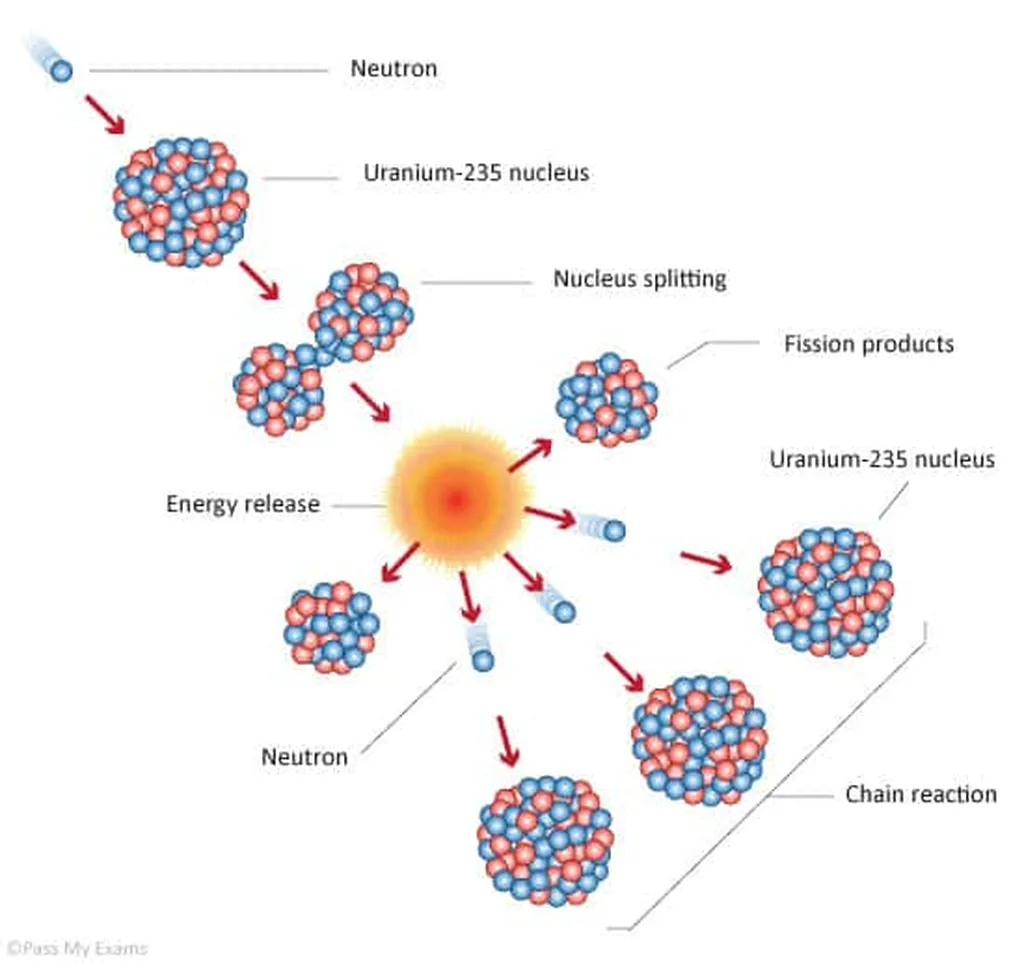
In the realm of nuclear physics and energy research, a team from the Warsaw University of Technology, led by Dr. Andrzej Augustyn, has delved into the intricate world of actinide nuclei fission properties. Their work, recently published in the journal Physical Review C, offers a refined exploration of the potential energy landscape of even-even actinide nuclei, from Thorium (Th) to Californium (Cf).
The researchers employed the Warsaw Macroscopic-Microscopic model, utilizing a novel five-dimensional Fourier-over-Spheroid (FoS) shape parameterization. This approach allowed them to create a large deformation grid, encompassing approximately 1.3 x 10^8 points for each nucleus. This extensive grid enabled a numerically complete exploration of the potential energy landscape without the need for dividing the configuration space into subregions or applying interpolation.
The study focused on fission barrier heights and static properties, which are crucial for understanding nuclear fission processes. The barrier heights, extracted via the Immersion Water Flow method, showed good agreement with empirical evaluations, including the new IAEA RIPL-4 dataset, with mean deviations below 1 MeV. This level of accuracy is significant for nuclear energy applications, as it enhances our understanding of fission processes, which are fundamental to nuclear power generation.
One of the key findings of the study was the identification of a shallow but distinct third well, or hyperdeformed minimum, in Thorium isotopes. This feature has been a subject of debate for some time. Interestingly, this third well was absent in heavier actinides like Uranium and Plutonium. This discovery could have implications for nuclear fuel cycles and waste management, as different actinides behave differently during fission.
The practical applications of this research are manifold. A deeper understanding of fission properties can lead to improvements in nuclear reactor design, fuel efficiency, and safety. It can also aid in the development of advanced nuclear fuels and the management of nuclear waste. Moreover, this research contributes to the broader field of nuclear physics, enhancing our knowledge of nuclear structure and behavior.
In conclusion, the work of Dr. Augustyn and his team represents a significant advancement in our understanding of actinide nuclei fission properties. Their refined exploration of the potential energy landscape offers valuable insights that can be applied to various aspects of the energy industry, particularly in the field of nuclear power.
This article is based on research available at arXiv.