
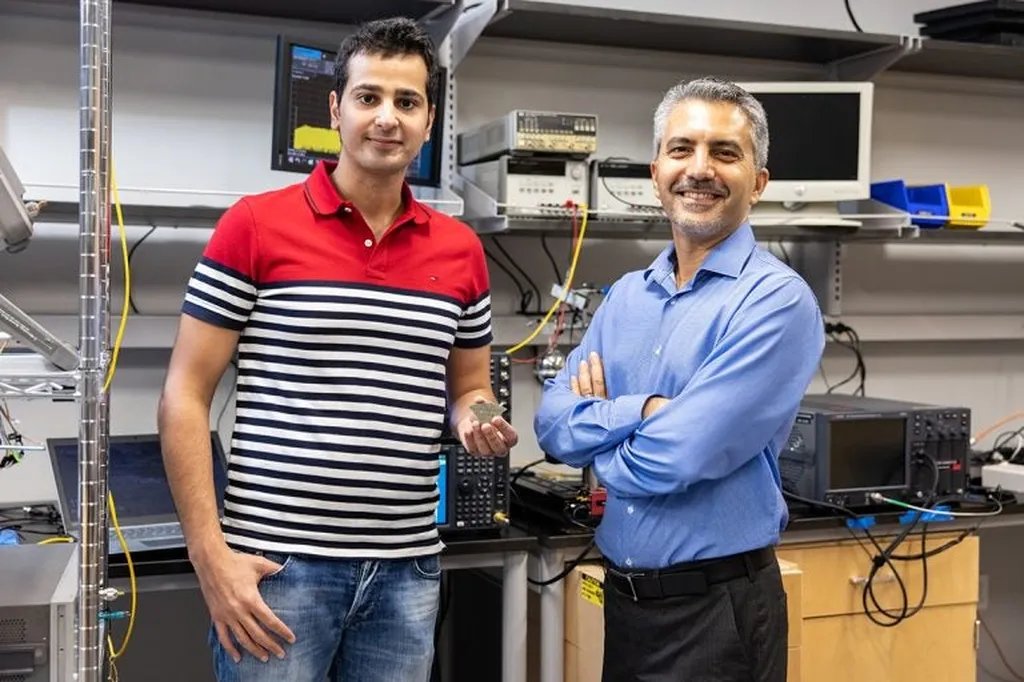
In the realm of energy research, understanding the fundamental physics of electronic transport is crucial for developing advanced materials and technologies. Researchers Elena Trukhan and Nakib H. Protik, affiliated with the University of Central Florida, have recently made significant strides in this area. Their work, published in the journal Physical Review B, focuses on refining the electronic Boltzmann transport equation to better account for interband effects and kinetic corrections.
The Boltzmann transport equation is a cornerstone in the study of electronic transport, providing a framework to understand how electrons move through materials under the influence of various forces. Traditionally, this equation has been used in a semiclassical context, but recent research has shown that interband effects, such as coherence and tunneling, can play a significant role in charge and heat transport under certain conditions. These effects can be captured by adding corrective terms to the semiclassical Boltzmann transport equation.
Trukhan and Protik’s work addresses some of the limitations in previous derivations of these transport equations. They start from the Keldysh formulation of the quantum kinetic equation, which provides a more comprehensive framework for describing electronic transport. One of the key contributions of their work is the consideration of the band non-diagonality of the electron-impurity and electron-phonon self-energies. This means they account for the interactions between different electronic bands, which can have a significant impact on transport properties.
The researchers introduce a minimally modified Kadanoff-Baym Ansatz, a mathematical approach used to simplify the quantum kinetic equation. This allows them to derive a quantum-corrected, matrix Boltzmann transport equation that goes beyond the current state of the art. They demonstrate that the occupations and coherences of electronic states are interdependent, and that the kinetic corrections due to the included interactions cannot, in general, be ignored.
The practical implications of this research for the energy sector are significant. A more accurate description of electronic transport can lead to better designs for electronic and thermoelectric materials. For example, understanding how electrons and heat move through materials is crucial for developing more efficient solar cells, thermoelectric generators, and other energy technologies. The refined Boltzmann transport equation derived by Trukhan and Protik provides a more accurate tool for predicting these transport properties, which can guide the development of new materials and devices.
In summary, Trukhan and Protik’s work represents a significant advancement in the theoretical understanding of electronic transport. By refining the Boltzmann transport equation to better account for interband effects and kinetic corrections, they have provided a more accurate tool for predicting the transport properties of materials. This research, published in Physical Review B, has important implications for the development of advanced energy technologies.
This article is based on research available at arXiv.