
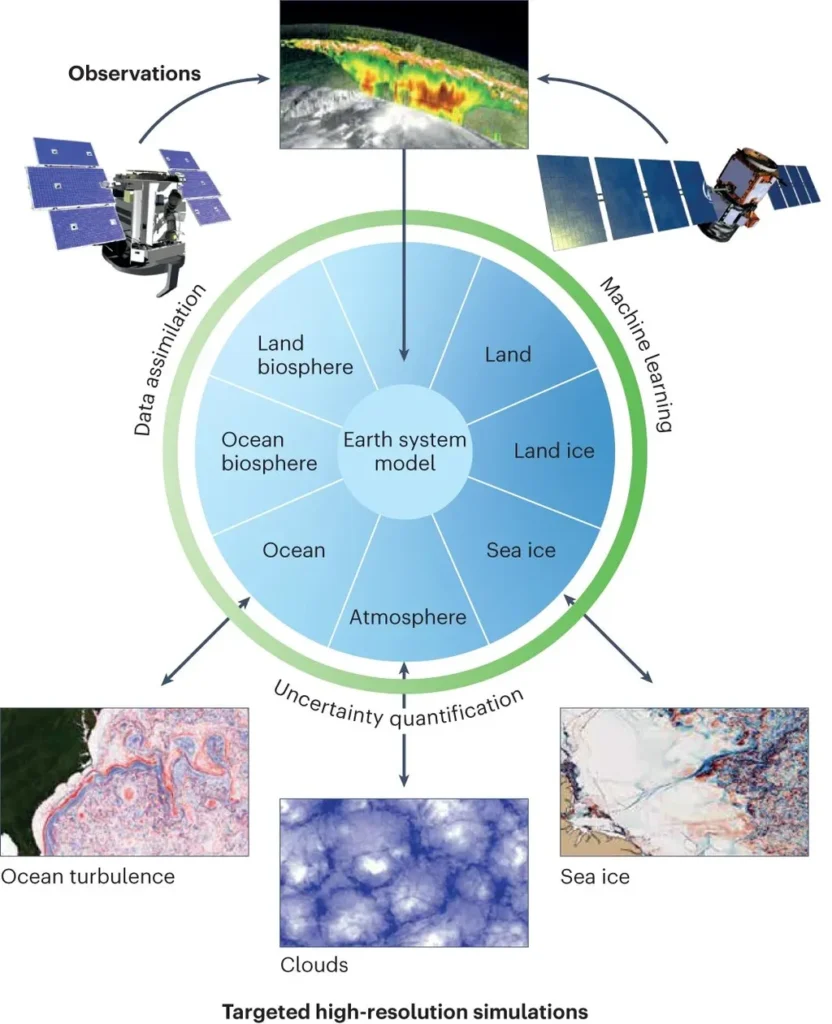
In the realm of energy and climate research, a team of scientists from the Massachusetts Institute of Technology (MIT) has developed a novel approach to improve the accuracy of ocean boundary layer simulations. The researchers, Xin Kai Lee, Ali Ramadhan, Andre Souza, Gregory LeClaire Wagner, Simone Silvestri, John Marshall, and Raffaele Ferrari, have introduced NORi, a machine-learned parameterization that enhances the representation of ocean boundary layer turbulence in climate models.
NORi, which stands for neural ordinary differential equations (NODEs) Richardson number (Ri) closure, combines traditional physics-based parameterization with the power of neural networks. The parameterization is controlled by a Richardson number-dependent diffusivity and viscosity. The NODEs are trained to capture the entrainment through the base of the boundary layer, a process that cannot be accurately represented with a local diffusive closure. The team trained NORi using large-eddy simulations in an “a posteriori” fashion, calibrating parameters with a loss function that depends on the actual time-integrated variables of interest, rather than the instantaneous subgrid fluxes, which are inherently noisy.
The researchers designed NORi to work with the realistic nonlinear equation of state of seawater. The parameterization demonstrates excellent prediction and generalization capabilities, accurately capturing entrainment dynamics under various conditions, including different convective strengths, oceanic background stratifications, rotation strengths, and surface wind forcings. Notably, NORi is numerically stable for at least 100 years of integration time in large-scale simulations, despite being trained on only 2-day horizons. It can also be run with time steps as long as one hour.
The practical applications of NORi for the energy sector are significant. Accurate ocean boundary layer simulations are crucial for improving climate models, which in turn enhance our understanding of climate change and its impacts on energy systems. Better climate models can inform renewable energy planning, such as offshore wind farm development, by providing more precise wind and wave predictions. Additionally, improved ocean simulations can aid in the assessment of marine energy resources and the potential impacts of climate change on these resources.
The research was published in the journal Nature Communications, offering a robust paradigm for designing parameterizations for climate models where data requirements are drastically reduced, inference performance can be directly targeted and optimized, and numerical stability is implicitly encouraged during training. This innovative approach holds promise for advancing the field of climate modeling and supporting the energy sector’s efforts to adapt to and mitigate climate change.
This article is based on research available at arXiv.