
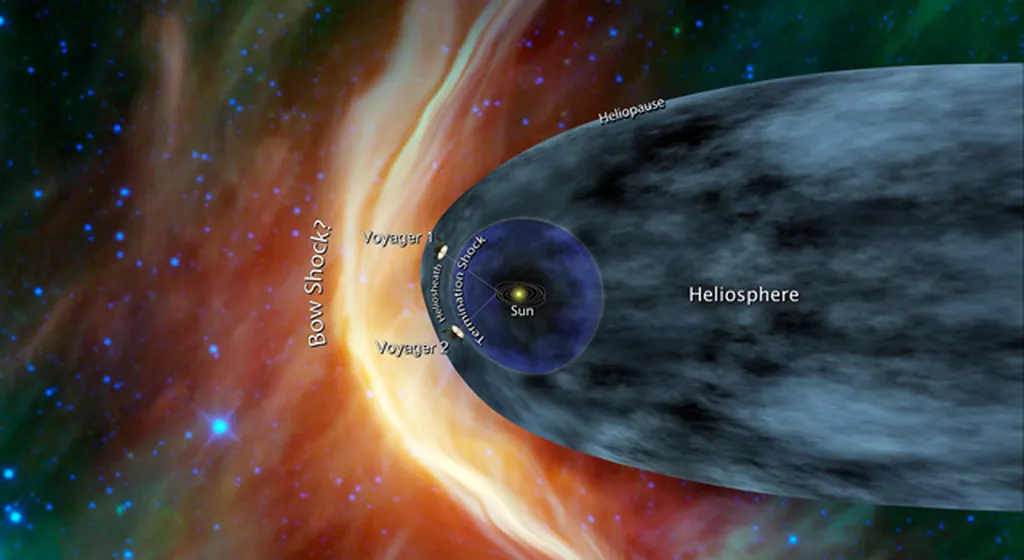
In the vast expanse of space, the Voyager 1 spacecraft continues to send back valuable data that helps scientists understand the interstellar medium (ISM) and cosmic rays (CRs). A team of researchers from NASA’s Goddard Space Flight Center and the University of Iceland has recently used this data to investigate how the local ISM affects the spectra of cosmic rays measured near our solar system. The researchers are Troy A. Porter, Igor V. Moskalenko, Alan C. Cummings, and Guðlaugur Jóhannesson.
The team utilized the GALPROP code, a sophisticated tool for modeling cosmic ray propagation, to explore how variations in the local gas and source distributions impact spectral features at low energies. By comparing their models with recent data from Voyager 1, they were able to constrain the distance of the nearest source of low-energy cosmic ray particles to be within the range of approximately 150-200 parsecs (pc) from the solar system. A parsec is a unit of distance used in astronomy, equivalent to about 3.26 light-years.
One of the key findings of this study is that the modeling supports the conclusion of a previous study by Cummings et al. (2025) that there is a significant fraction of primary Boron in its observed spectrum at low energies. This is an important detail because Boron is typically considered a secondary cosmic ray, meaning it is produced by the interaction of primary cosmic rays with the interstellar medium. The presence of primary Boron suggests that there are nearby sources contributing to the low-energy cosmic ray spectrum.
The researchers emphasize that detailed modeling of the immediate Galactic environment is crucial for robustly inferring Galactic CR propagation parameters from local measurements. They also note that accounting for nearby ISM structure can help alleviate tensions between direct CR data and global propagation models. This work highlights the importance of considering local interstellar conditions when interpreting cosmic ray data, which can have implications for understanding the propagation of cosmic rays throughout the galaxy.
This research was published in the Astrophysical Journal, a peer-reviewed scientific journal that publishes original research on all aspects of astronomy and astrophysics. The findings contribute to our understanding of cosmic rays and the interstellar medium, which can have practical applications in the energy sector, particularly in space-based solar power and radiation shielding for spacecraft and satellites. Understanding the local cosmic ray environment is essential for designing and operating energy systems in space, as cosmic rays can pose significant challenges to their performance and reliability.
This article is based on research available at arXiv.