
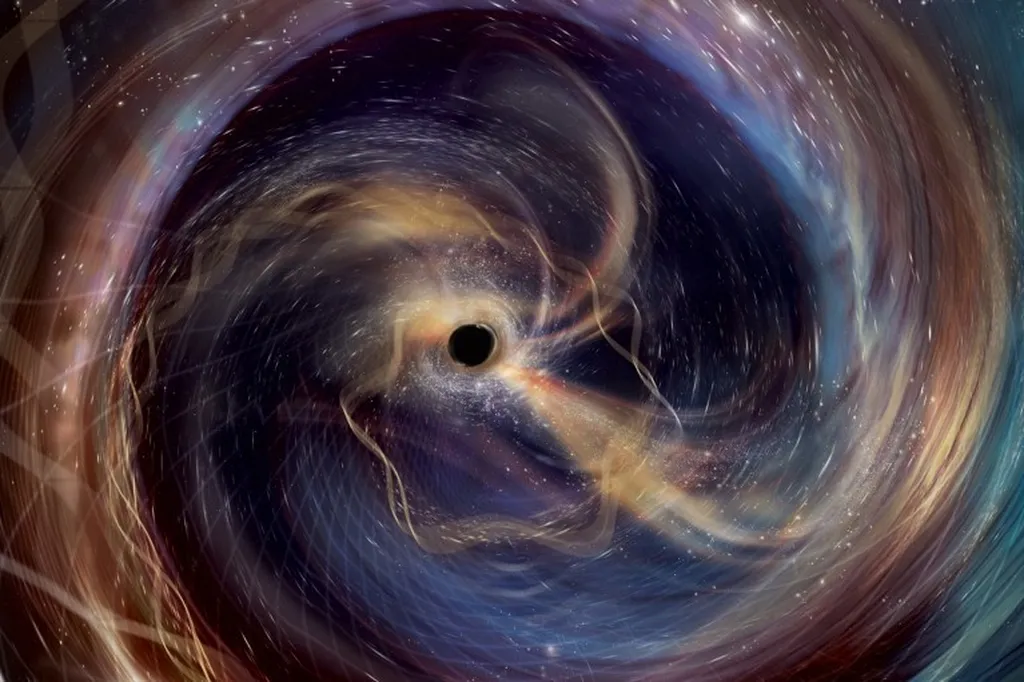
Researchers B. Eslam Panah, N. Heidari, and M. Soleimani from the Department of Physics at the University of Tehran have delved into the intricate world of black holes, exploring their thermodynamic and optical properties within a unique gravitational framework. Their work, published in the journal Physical Review D, integrates the dilaton field, which serves as an ultraviolet (UV) correction, and dRGT-like massive gravity, an infrared (IR) correction, into Einstein gravity.
The researchers began by reviewing black hole solutions within this Maxwell-dilaton-dRGT-like massive gravity framework. They analyzed how various parameters influence the spacetime’s asymptotic behavior and the event horizon of these black holes. The team paid particular attention to the effects of parameters such as β, α, and the massive parameters (η₁ and η₂) on the local stability of these black holes. They evaluated the heat capacity and temperature simultaneously to understand these effects better.
To study phase transitions, the researchers adopted an alternative method known as geometrothermodynamics. They also explored how the parameters of Maxwell-dilaton-dRGT-like massive gravity impact the optical characteristics and radiative behavior of black holes. Specifically, they analyzed the effects of the dilaton coupling constant (α), charge (q), the massive gravity parameter (η₁), and the graviton mass (m_g) on the radius of the photon sphere and the resulting black hole shadow. The theoretical shadow radius was compared to observational data from Sagittarius A* (Sgr A*), the supermassive black hole at the center of our galaxy.
Furthermore, the researchers investigated the energy emission rate of these black holes, revealing that the aforementioned parameters substantially influence the emission peak. This research provides a deeper understanding of black hole thermodynamics and optics, which could have implications for the energy sector, particularly in the context of energy generation and radiation analysis. The findings could potentially contribute to the development of more efficient energy systems and a better understanding of cosmic energy phenomena.
The study, titled “Some perspective of thermodynamical and optical properties of black holes in Maxwell-dilaton-dRGT-like massive gravity,” offers a comprehensive analysis of black hole properties within a complex gravitational framework, shedding light on the intricate interplay between various parameters and their effects on black hole behavior. This research not only advances our theoretical understanding of black holes but also holds practical implications for the energy industry.
This article is based on research available at arXiv.