
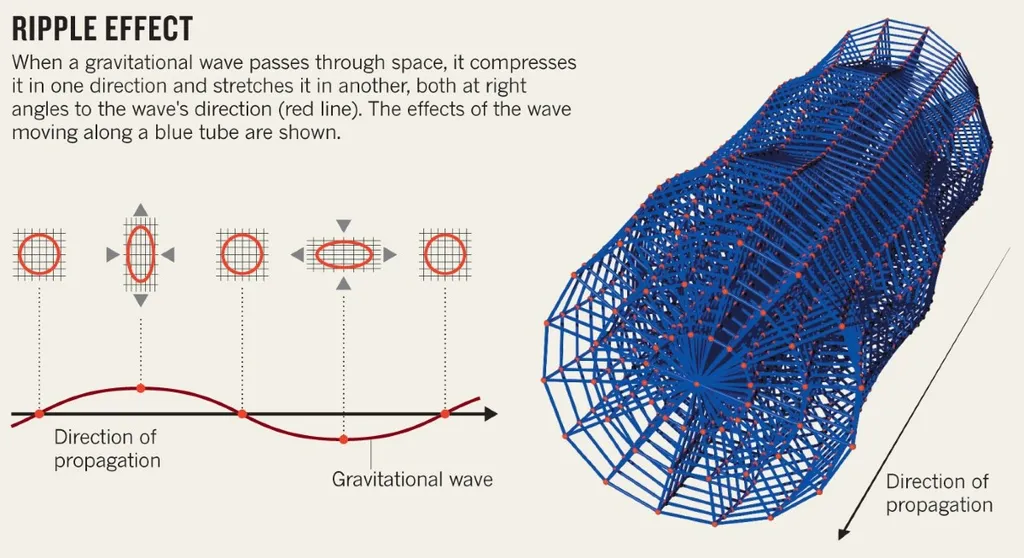
Researchers Giuseppe Fanizza, Eliseo Pavone, and Luigi Tedesco from the University of Salento in Italy have published a study in the Journal of Cosmology and Astroparticle Physics exploring the impact of shear viscosity on the propagation of primordial gravitational waves (pGWs) after inflation. Their work provides insights into how these cosmic ripples might be altered by the presence of shear viscosity in the early universe, which could have implications for our understanding of the early universe and the energy density of gravitational waves.
The researchers focused on the evolution of pGWs after they re-enter the horizon during a cosmological epoch characterized by shear viscosity. They did not assume a specific inflationary scenario, allowing their findings to be broadly applicable. The study reveals that shear viscosity introduces an additional damping term in the tensor equation, which modifies both the transfer function and the energy density power spectrum of gravitational waves.
For a constant shear viscosity-to-Hubble ratio, the transfer function acquires an extra red tilt. This means that the amplitude of the gravitational wave signal decreases more rapidly at higher frequencies. Conversely, a time-dependent viscosity leads to a running spectral index, where the energy density of gravitational waves varies as a function of frequency in a manner controlled by the time evolution of the mean free path of the viscous fluid. This effect could provide a unique signature in the gravitational wave background that could be detected by future experiments.
As a case study, the researchers evaluated the effect of the viscosity of the electron-photon-baryon plasma on both the transfer function and the normalized energy density. They found a k-dependent blue tilt due to gravitational wave freeze-out from the viscous phase. This effect corresponds to a fractional difference of order 10^-3, which is a relatively small but potentially measurable deviation from the expected spectrum.
The practical applications of this research for the energy sector are indirect but significant. Understanding the behavior of gravitational waves in the early universe can provide insights into the fundamental physics that governs the cosmos. This knowledge can inform the development of new technologies and energy sources that harness the principles of gravitational wave physics. Additionally, the study of primordial gravitational waves can help us better understand the conditions of the early universe, which can have implications for the formation of stars and galaxies, and ultimately, the distribution of matter and energy in the universe.
In summary, the research by Fanizza, Pavone, and Tedesco sheds light on how shear viscosity can alter the primordial gravitational wave background. Their findings provide a general framework for analytically quantifying these effects in both standard and non-standard post-inflationary scenarios. This work contributes to our understanding of the early universe and the fundamental forces that shape it, with potential implications for the energy sector and beyond.
This article is based on research available at arXiv.