
In the rapidly evolving landscape of wireless networks, researchers Ghoshana Bista, Abbas Bradai, Emmanuel Moulay, and Abdulhalim Dandoush from the University of Technology Sydney have been exploring innovative ways to enhance 5G networks using Unmanned Aerial Vehicles (UAVs). Their recent study, published in the IEEE Internet of Things Journal, delves into the application of Multi-Agent Deep Reinforcement Learning (MADRL) to optimize UAV-assisted 5G network slicing.
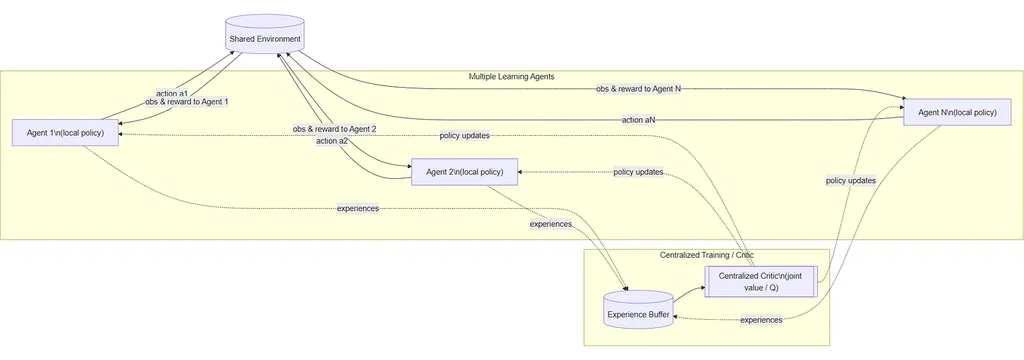
The study introduces a MADRL framework that integrates three algorithms: Proximal Policy Optimization (MAPPO), Multi-Agent Deep Deterministic Policy Gradient (MADDPG), and Multi-Agent Deep Q-Networks (MADQN). This framework aims to jointly optimize UAV positioning, resource allocation, Quality of Service (QoS), and energy efficiency. The researchers adopted a Centralized Training with Decentralized Execution (CTDE) approach, enabling autonomous real-time decision-making while maintaining global coordination.
The framework categorizes users into three slices: Premium (A), Silver (B), and Bronze (C), each with distinct QoS requirements. The researchers conducted experiments in both urban and rural scenarios to evaluate the performance of the three algorithms. They found that MAPPO achieved the best overall QoS-energy tradeoff, particularly in interference-rich urban environments. MADDPG, on the other hand, offered more precise continuous control and could attain slightly higher Signal-to-Interference-plus-Noise Ratio (SINR) in open rural settings, but at the cost of increased energy usage. MADQN provided a computationally efficient baseline for discretized action spaces.
The study highlights that no single MADRL algorithm is universally dominant; instead, the suitability of an algorithm depends on environmental topology, user density, and service requirements. This research underscores the potential of MADRL-driven UAV systems to enhance scalability, reliability, and differentiated QoS delivery in next-generation wireless networks.
For the energy sector, this research could have significant implications. As the demand for robust and scalable wireless networks grows, so does the need for efficient and reliable energy solutions to power these networks. The integration of UAVs as mobile base stations, optimized through MADRL, could lead to more energy-efficient network operations, reducing the overall energy consumption of wireless networks. This could be particularly beneficial in dense urban areas where energy consumption is high and in underserved rural areas where energy infrastructure may be limited.
Moreover, the ability to prioritize users into different slices based on their QoS requirements could enable energy providers to offer differentiated services, catering to the specific needs of their customers. This could lead to more efficient use of network resources and energy, ultimately reducing costs and improving service quality.
In conclusion, the research by Bista, Bradai, Moulay, and Dandoush presents a promising approach to optimizing UAV-assisted 5G network slicing using MADRL. The findings could have significant practical applications for the energy sector, paving the way for more efficient and reliable wireless networks.
This article is based on research available at arXiv.