
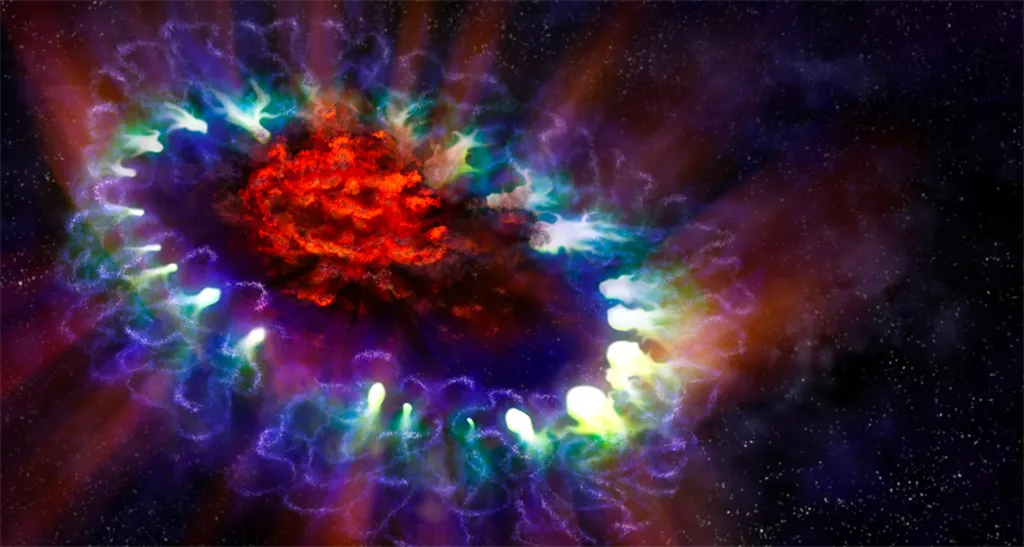
In the realm of astrophysics and energy research, a team of scientists led by M. D. Stritzinger from Aarhus University, Denmark, has been studying a particular type of supernova, SN 2020lao, to understand its explosion dynamics and energy output. The team, which includes researchers from various institutions worldwide, has published their findings in the Astrophysical Journal.
Supernovae are powerful stellar explosions that can release an enormous amount of energy, sometimes even outshining entire galaxies for a short period. The researchers focused on a specific type of supernova known as a broad-lined Type Ic supernova (SN Ic-BL), which is believed to be linked to some of the most energetic phenomena in the universe, such as gamma-ray bursts and relativistic jets.
The team observed SN 2020lao shortly after its explosion, using data from the Transiting Exoplanet Survey Satellite (TESS) and the Zwicky Transient Facility (ZTF). They found that the supernova’s light curve rose rapidly, reaching peak luminosity in just 8.8 days. This peak luminosity was typical of other SNe Ic-BL events. Notably, SN 2020lao did not exhibit any early optical excess or afterglow, which are sometimes seen in engine-driven events.
The researchers used Arnett modeling to analyze the bolometric light curve of SN 2020lao, which combines data from different wavelengths to give a total energy output. They estimated that the supernova produced about 0.2 solar masses of nickel, had an ejecta mass of about 3.2 solar masses, and released a kinetic energy of approximately 23 x 10^51 erg. This corresponds to a high specific kinetic energy of about 7 x 10^51 erg per solar mass. Spectral-synthesis modeling suggested a somewhat lower but still substantial specific kinetic energy of about 5 x 10^51 erg per solar mass.
Despite its high specific kinetic energy, SN 2020lao did not show any signs of relativistic ejecta or dense circumstellar material. Published VLA and Swift/XRT non-detections placed strong limits on these factors, implying that any potential jet was either far off-axis or choked. This makes SN 2020lao an unusual case among SNe Ic-BL, as it represents an extreme non-relativistic event.
The practical applications of this research for the energy sector are indirect but significant. Understanding the mechanisms behind such powerful explosions can provide insights into the fundamental physics of energy release and transfer. This knowledge can potentially inform the development of advanced energy technologies, such as fusion energy, which aims to harness the power of nuclear reactions similar to those occurring in stars. Additionally, studying the progenitors of supernovae, like the compact Wolf-Rayet stars, can help scientists better understand the life cycles of stars and the conditions leading to their explosive deaths.
In conclusion, the research on SN 2020lao offers valuable insights into the dynamics of broad-lined Type Ic supernovae and their energy output. While the direct applications to the energy industry may be limited, the fundamental understanding gained from such studies can contribute to the broader field of energy research and technology development. The findings were published in the Astrophysical Journal, a leading journal in the field of astrophysics.
This article is based on research available at arXiv.