
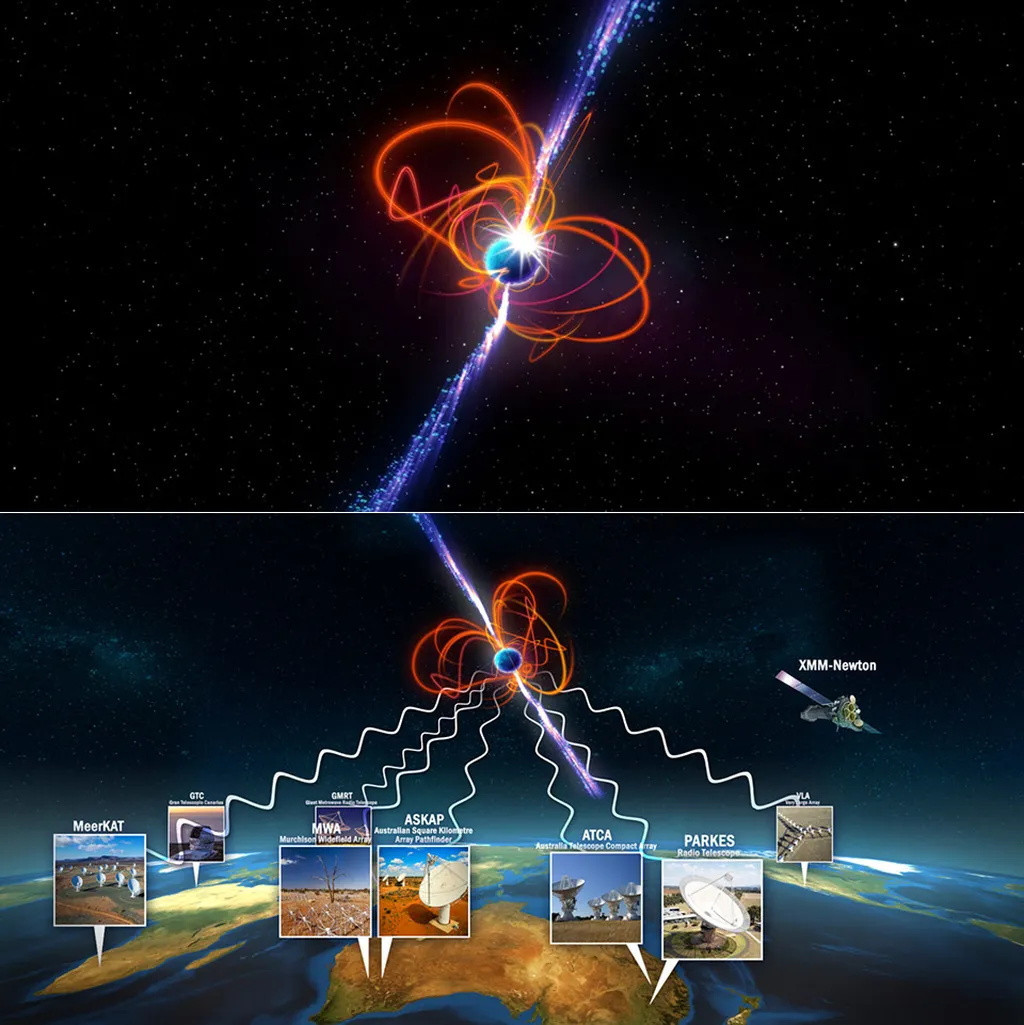
In a recent study, researchers Isaiah I. Tristan, Rachel A. Osten, Yuta Notsu, Adam F. Kowalski, and Steven R. Cranmer from various institutions, including the University of California, Berkeley, and the National Radio Astronomy Observatory, investigated the quiescent radio emissions from AU Mic, an active M-dwarf flare star. Their findings were published in the Astrophysical Journal.
The team analyzed data collected during a seven-day multiwavelength campaign in October 2018, using the Very Large Array and the Australia Telescope Compact Array. They focused on the star’s quiescent, or non-flaring, state, examining radio frequencies between 12 and 25 GHz.
The researchers found that the quiescent radio spectrum of AU Mic could be broken down into two distinct components. One component showed a decreasing intensity with increasing frequency, while the other remained flat across the observed frequency range. The flat component had a relatively steady flux density of approximately 0.64 milliJanskys, with some variation.
The falling component was consistent with nonthermal, optically thin gyrosynchrotron radiation, a type of emission typically associated with high-energy electrons spiraling around magnetic field lines. This component exhibited a spectral index of -0.88, similar to what has been observed during flares from AU Mic.
The flat component, however, did not fit well with traditional models of thermal, optically thin free-free emission. The inferred mass-loss rate and flux density were too high compared to previous theoretical models and observations of stellar winds and X-ray emissions. Instead, the researchers proposed that this flat component could be explained by optically thick gyroresonance radiation integrated over multiple source regions, resulting in a composite spectrum that appears flat.
The persistence of these components across the star’s rotational period suggests the presence of multiple source regions. This could help explain variations in flux density and the persistent presence of high-energy electrons in the star’s atmosphere.
While this research focuses on stellar physics, understanding the behavior of M-dwarf stars like AU Mic can have implications for the energy sector, particularly in the development of space-based solar power systems. These systems rely on the collection and conversion of solar energy in space, and a better understanding of stellar activity and radiation can help improve the design and efficiency of such systems. Additionally, insights into the behavior of high-energy electrons and magnetic fields in stars can contribute to the development of advanced fusion energy technologies.
The study, titled “A 7 Day Multiwavelength Flare Campaign on AU Mic. IV: Quiescent Gyrosynchrotron and Gyroresonance Radiation from 12 to 25 GHz,” was published in the Astrophysical Journal.
This article is based on research available at arXiv.