
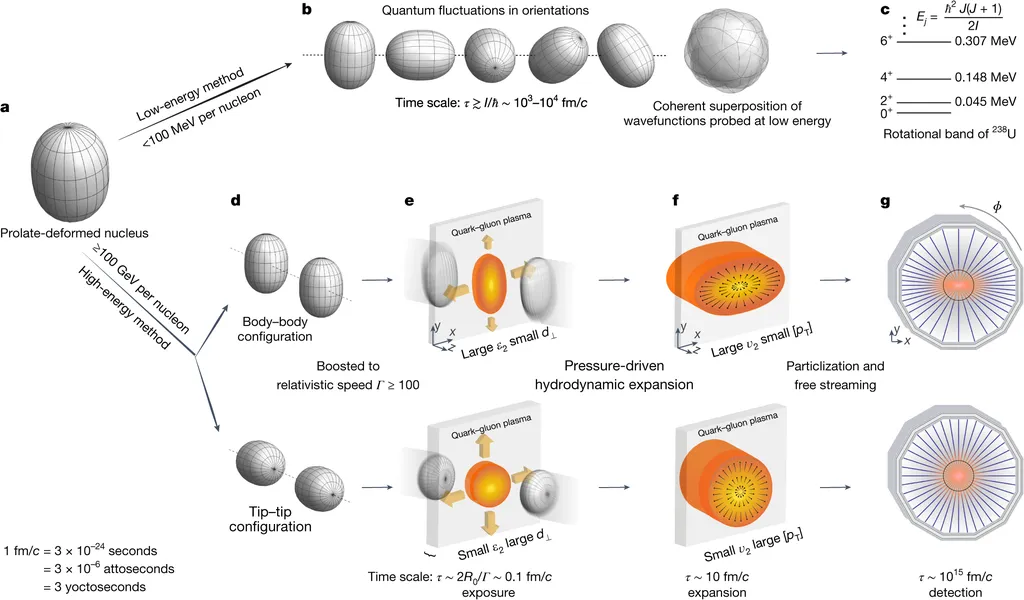
In the realm of nuclear physics, researchers Manu Kanerva and Markus Kortelainen from the University of Jyväskylä in Finland have been delving into the intricate world of nuclear resonances and their implications for theoretical models. Their recent study, published in the journal Physical Review C, focuses on the impact of octupole deformation on the nuclear electromagnetic response, a topic that has seen relatively less attention compared to other collective phenomena in nuclear matter.
The study aims to investigate how the breaking of reflection symmetry due to octupole deformation affects electric and magnetic transition strengths in atomic nuclei. To achieve this, the researchers employed linear response theory using the iterative finite amplitude method (FAM) to solve quasiparticle random phase approximation (QRPA)-type equations. The ground-state solutions were obtained within the framework of axially symmetric Skyrme-Hartree-Fock-Bogoliubov (HFB) using three different Skyrme functionals.
The researchers calculated electric and magnetic multipole responses for octupole-deformed even-even isotopes of radium, thorium, uranium, plutonium, and curium. These calculations were performed on top of two distinct deformed ground-state solutions: one constrained to conserve parity, and the other allowing parity breaking. Sum rules were also calculated from M1 transition strengths and compared with expected correlations to certain ground-state properties.
The results of the study indicate that octupole deformation has only a modest effect on the transition strengths in the resonances. However, M1 transition strengths were found to have a greater impact at lower energies (0-8 MeV), suggesting the need for further investigation in this area. Additionally, the isoscalar E3 transition strength was confirmed to have a significant contribution from the rotational Nambu-Goldstone (NG) mode in the parity-breaking HFB solution, necessitating its removal for accurate calculations.
While this research is primarily focused on advancing our understanding of nuclear physics, it also has potential implications for the energy sector, particularly in the field of nuclear energy. A deeper understanding of nuclear resonances and their properties can contribute to the development of more accurate theoretical models, which in turn can aid in the design and optimization of nuclear reactors and other nuclear energy technologies. Furthermore, insights into the behavior of heavy isotopes like those of uranium and plutonium can have direct relevance to nuclear fuel cycles and waste management strategies.
In conclusion, the work of Kanerva and Kortelainen sheds light on the nuanced effects of octupole deformation on nuclear electromagnetic responses, providing valuable data for refining theoretical models in nuclear physics. Their findings not only advance our fundamental understanding of nuclear matter but also hold practical implications for the energy industry, particularly in the realm of nuclear energy technologies.
This article is based on research available at arXiv.