
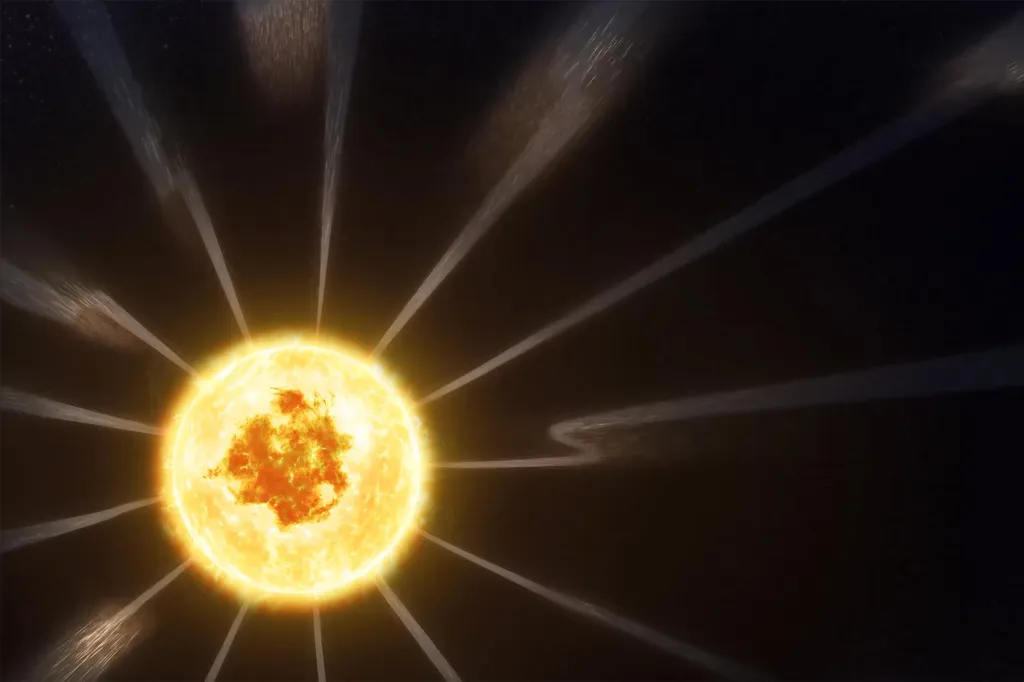
In a recent study, researchers Alphonse C. Sterling, Louise K. Harra, Navdeep K. Panesar, and Ronald L. Moore from NASA’s Marshall Space Flight Center and the University of Alabama in Huntsville have uncovered new insights into solar phenomena that could have implications for our understanding of solar wind and space weather. Their work, published in The Astrophysical Journal, focuses on the detection of strong Doppler shifts in solar spectra, which are typically associated with highly dynamic and explosive events like solar flares.
The team analyzed data from the Hinode EUV Imaging Spectrometer (EIS) and found exceptionally strong blueshifts of around 200 km/s in the 195 Angstrom wavelength, even in the absence of a flare-like brightening. These shifts were detected at the edge of an active region on the Sun. Despite the event being too weak to register in GOES Soft X-ray fluxes, the EIS data pinpointed the source of these shifts. Further investigation using the Solar Dynamics Observatory’s Atmospheric Imaging Assembly (AIA) images and Helioseismic and Magnetic Imager (HMI) magnetograms revealed a small-scale eruptive event at the location of the blueshifts. This event is likely an inconspicuous coronal jet, triggered by the convergence and cancellation of magnetic flux patches, with a plane-of-sky velocity of approximately 159 km/s.
The researchers suggest that these strong Doppler shifts are indeed due to a coronal jet that is challenging to detect in AIA images. The study also highlights that EUV Doppler maps are a more sensitive tool for detecting small-scale eruptions than EUV images. These eruptions, often triggered by magnetic flux cancellation, can produce small-scale coronal-jet-like features that might contribute to the solar wind.
For the energy sector, understanding these small-scale eruptions and their role in driving the solar wind is crucial. Solar wind and space weather events can impact satellite operations, power grids, and other energy infrastructure. By improving our ability to detect and understand these events, we can better predict and mitigate their effects on our energy systems. The research underscores the importance of advanced solar observation techniques in enhancing our predictive capabilities and safeguarding critical infrastructure.
The research was published in The Astrophysical Journal, a peer-reviewed scientific journal that covers astronomical and astrophysical topics.
This article is based on research available at arXiv.