
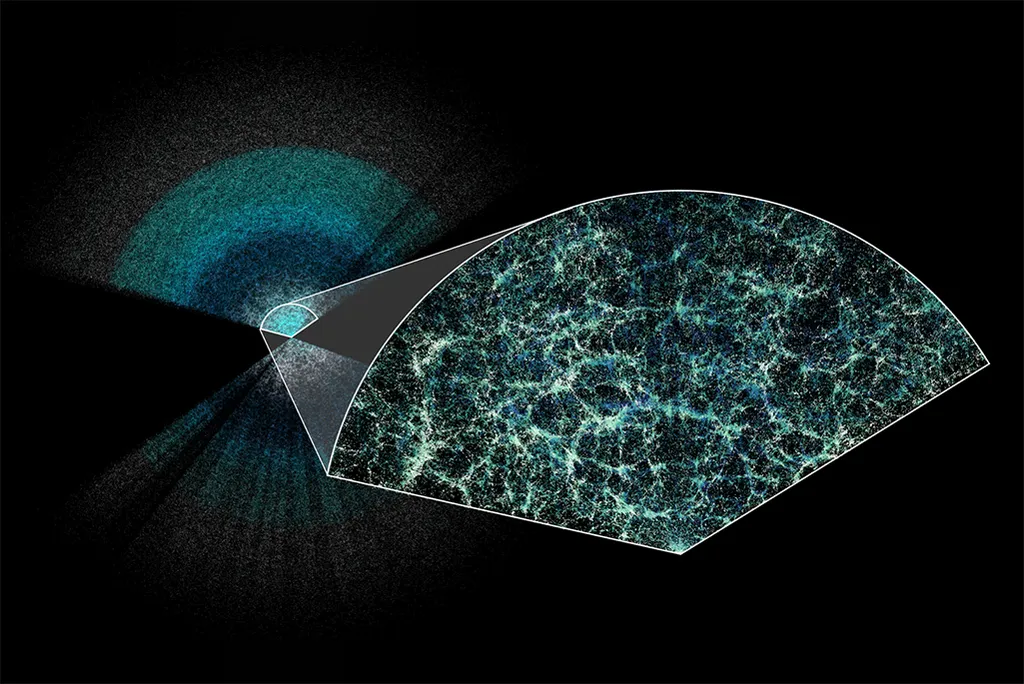
Researchers Rajdeep Mazumdar, Kalyan Malakar, and Kalyan Bhuyan from the Department of Physics at Tezpur University in India have published a study that explores a new approach to understanding the accelerating expansion of the universe, a phenomenon often attributed to dark energy. Their work, titled “Fractional Holographic Dark Energy Driven Reconstruction of f(Q) Gravity and its Cosmological Implications,” was published in the journal Physical Review D.
The study introduces a reconstructed version of f(Q) gravity theory, which is a modified theory of gravity that extends Einstein’s general relativity. This new model is inspired by integrating fractional holographic dark energy with the Hubble horizon as an infrared cutoff. The researchers aimed to create a geometrically motivated dark energy component that naturally recovers general relativity under appropriate conditions.
To validate their model, the researchers constrained its free parameters using the latest data from the Dark Energy Spectroscopic Instrument (DESI) Baryon Acoustic Oscillations (BAO), previous BAO compilations, and cosmic chronometer datasets. They employed a Markov Chain Monte Carlo (MCMC) analysis to achieve this. The reconstructed Hubble parameter H(z) showed excellent consistency with observational data, demonstrating high R-squared values and low chi-squared, Akaike Information Criterion (AIC), and Bayesian Information Criterion (BIC) values. This indicates that the model performs well statistically compared to the standard Lambda Cold Dark Matter (ΛCDM) model.
The study also analyzed the model’s dynamical diagnostics, revealing a smooth transition from a decelerated to an accelerated phase of the universe’s expansion. The transition redshift was found to be around 0.56 to 0.72, with a current deceleration parameter q(0) ranging from -0.40 to -0.32. The Om(z) diagnostic showed a negative slope, suggesting that the model deviates from the ΛCDM model. However, the effective equation-of-state parameter ω_eff(z) remained within the quintessence regime, indicating that the model describes a type of dark energy known as quintessence.
The researchers also examined the classical energy conditions, finding that the Weak Energy Condition (WEC), Dominant Energy Condition (DEC), and Null Energy Condition (NEC) were satisfied throughout cosmic evolution. The Strong Energy Condition (SEC) was violated at lower redshifts, consistent with the observed late-time acceleration of the universe. Additionally, a linear homogeneous perturbation analysis confirmed the model’s dynamical stability.
In conclusion, the study presents a stable, observationally compatible, and geometrically motivated alternative to the ΛCDM model. This new approach successfully describes the late-time cosmic acceleration within the symmetric teleparallel framework, offering valuable insights for the energy sector, particularly in understanding the fundamental drivers of the universe’s expansion and the nature of dark energy.
The research was published in Physical Review D, a peer-reviewed scientific journal published by the American Physical Society.
This article is based on research available at arXiv.