
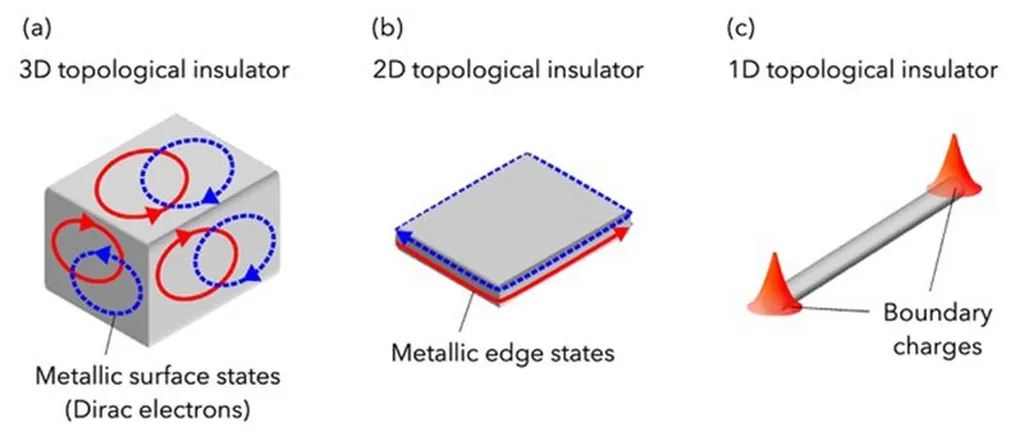
Researchers Minakshi Subhadarshini, Amartya Pal, and Arijit Saha from the Indian Institute of Science Education and Research (IISER) Pune have proposed a novel theoretical framework that could significantly impact the development of advanced electronic devices in the energy sector. Their work focuses on engineering higher-order topological phases in three-dimensional topological insulators by coupling them with a specific type of magnetic material known as altermagnets (AMs).
The researchers propose that by coupling topological insulators with altermagnets that exhibit a specific type of magnetic ordering (d_{x^2-y^2}-type), a hybrid-order topological phase can be achieved. This phase is unique because it allows both first-order and second-order topological phases to coexist. The team characterized this phase through spectral analysis, low-energy surface theory, and dipolar and quadrupolar winding numbers. They also confirmed its signature through two-terminal differential conductance calculations. This hybrid phase could potentially lead to more robust and versatile electronic devices, which are crucial for the energy sector’s demand for efficient power management and conversion systems.
Furthermore, the researchers found that incorporating another type of altermagnetic ordering (d_{x^2-z^2}-type) drives the system into two distinct second-order topological insulator phases. These phases host unique one-dimensional hinge modes, which are localized and directional. The key breakthrough here is the ability to control the localization and direction of these hinge modes by tuning the relative strengths of the altermagnetic exchange orders. This tunability is a significant advancement, as it enables the development of current-switching behaviors mediated via these hinge modes.
The practical applications of this research for the energy sector are substantial. The ability to engineer and control higher-order topological phases could lead to the development of more efficient and compact electronic devices. These devices could be used in various energy applications, such as advanced power electronics, energy storage systems, and renewable energy integration. The tunable current-switching behavior proposed by the researchers could also contribute to the development of more sophisticated control systems for energy distribution and management.
The research was published in the journal Physical Review B, a reputable source for cutting-edge research in condensed matter physics and materials science. While the work is theoretical, it lays a solid foundation for future experimental studies and technological developments in the energy sector. As the energy industry continues to evolve, advancements in materials science and topological physics, such as those proposed by Subhadarshini, Pal, and Saha, will play a crucial role in shaping the future of energy technologies.
This article is based on research available at arXiv.