
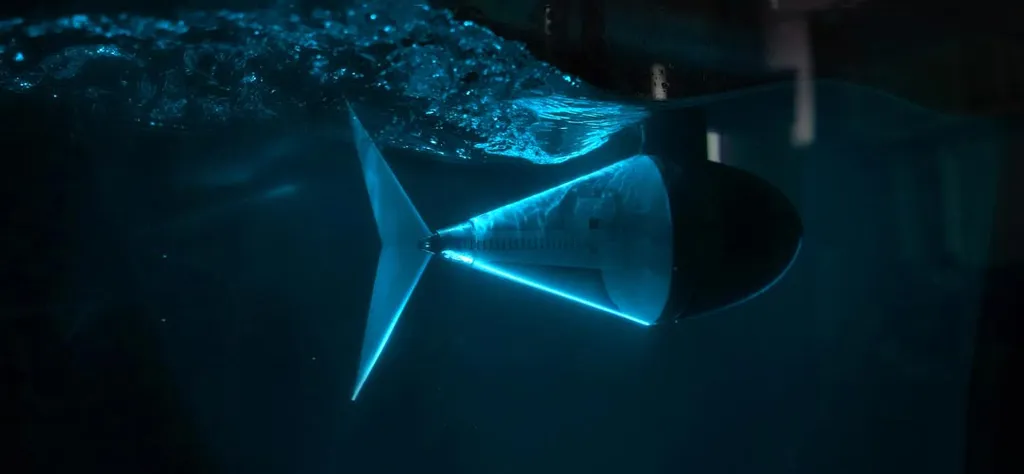
Researchers from the University of California, San Diego, led by Zahra Maleksabet, have delved into the intricate world of fish swimming dynamics to uncover insights that could inspire the design of next-generation underwater robots. The team, including Maham Kamran, Ali Tarokh, and Muhammad Saif Ullah Khalid, explored how different swimming styles and patterns influence the hydrodynamic forces and wake structures around fish.
The study focused on two types of swimmers: anguilliform, like eels, which spread motion along their entire bodies, and carangiform, like jack fish, which primarily move their tails. The researchers examined the impact of duty cycle (DC), undulatory gaits, and Strouhal number (St) on the near-body vortices and overall wakes. Duty cycle refers to the proportion of time a swimmer is actively propelling itself, while Strouhal number is a dimensionless quantity describing the oscillating motion of the swimmer.
Through three-dimensional simulations at a Reynolds number of 3000, the team found that both types of swimmers produce bow-shaped wakes when employing burst-and-coast motion, an intermittent swimming pattern. As the duty cycle increases to 1.0, corresponding to continuous undulation, the wake becomes more coherent. Interestingly, the study revealed that intermittent motion at a higher Strouhal number generates more drag compared to continuous undulatory kinematics.
The researchers quantified the strengths of vortices produced around the swimmers and analyzed the role of different body sections in generating unsteady streamwise forces. These findings provide valuable connections between the swimmers’ physiologies, their kinematics, and the governing vortex dynamics. The insights gained from this study could be instrumental in designing bio-inspired underwater robots that mimic the efficient swimming strategies of fish.
The research was published in the Journal of Fluid Mechanics, offering a deeper understanding of the hydrodynamic principles that govern fish swimming and paving the way for innovative advancements in underwater robotics. For the energy sector, particularly in offshore and marine energy applications, these insights could lead to more efficient and agile underwater vehicles for inspection, maintenance, and data collection in challenging environments.
This article is based on research available at arXiv.