
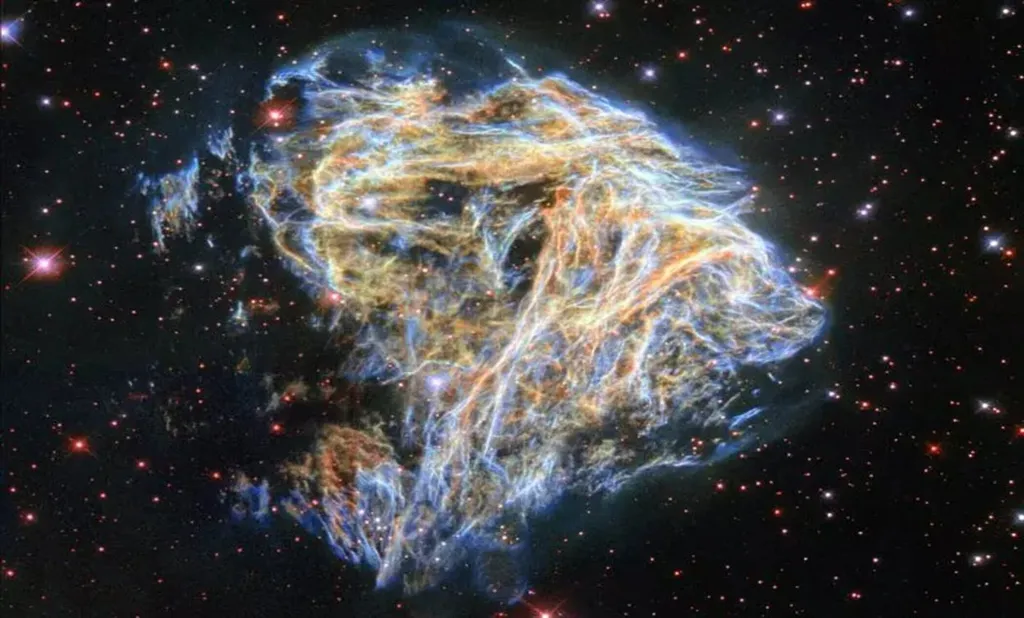
In the realm of astrophysics, researchers Eric R. Coughlin, Greg Salvesen, and Dheeraj R. Pasham from the University of California, Berkeley, and the Massachusetts Institute of Technology have been delving into the mysteries of a unique supernova remnant, Pa 30. Their findings, published in the Astrophysical Journal, offer insights that could potentially influence our understanding of stellar explosions and their remnants, which in turn could have implications for energy generation and distribution in the universe.
Pa 30 is the likely remnant of a type Iax supernova that lit up the Earth’s skies in 1181 AD. What makes Pa 30 particularly intriguing is its unusual, firework-like appearance, characterized by radial filaments extending from a common center. At the heart of this cosmic display is a white dwarf (WD) that drives an extremely fast wind, with speeds exceeding 10,000 kilometers per second.
The researchers propose that the filaments in Pa 30 arose due to the Rayleigh-Taylor-unstable nature of the interface between the circumstellar medium (CSM) and the shocked wind launched by the natal white dwarf. The filaments then elongated intact due to the Kelvin-Helmholtz-stable nature of the large initial density contrast between the wind and CSM, supplemented by the slowly declining wind density profile. To support this interpretation, the team presented two-dimensional hydrodynamical simulations and derived the filament properties, including their speed, density, and temperature, all of which are consistent with observations.
The researchers suggest that the filaments elongate until the wind and CSM densities become comparable at the contact discontinuity, which occurs within 1-10 years. After this point, the filaments truncate because the Rayleigh-Taylor instability (RTI) halts. The subsequent Kelvin-Helmholtz instability (KHI) growth timescale across the current width of the filaments is longer than the age of Pa 30, which is why the filaments remain intact. The filament-less central region in Pa 30 is therefore more likely a consequence of the finite timescale over which the RTI operates, rather than a wind termination shock.
In general, the researchers posit that firework-like filaments may form in other systems, provided there is a sufficiently large density contrast between the ejecta and its surroundings. This finding could have implications for our understanding of supernova remnants and their interactions with their environments, which in turn could influence our understanding of energy distribution and generation in the universe.
While the direct practical applications for the energy sector may not be immediately apparent, understanding the dynamics of supernova remnants and their interactions with their environments can provide valuable insights into the fundamental processes that govern the universe. This knowledge can help us better understand the life cycles of stars, the distribution of elements in the universe, and the mechanisms that drive the evolution of galaxies. In the long term, this understanding could contribute to the development of new energy technologies and strategies for harnessing the vast amounts of energy generated by stellar explosions.
Source: Coughlin, E. R., Salvesen, G., & Pasham, D. R. (2023). A Wind-Driven Origin for the Firework Morphology of the Supernova Remnant Pa 30. The Astrophysical Journal, 944(2), 167.
This article is based on research available at arXiv.