
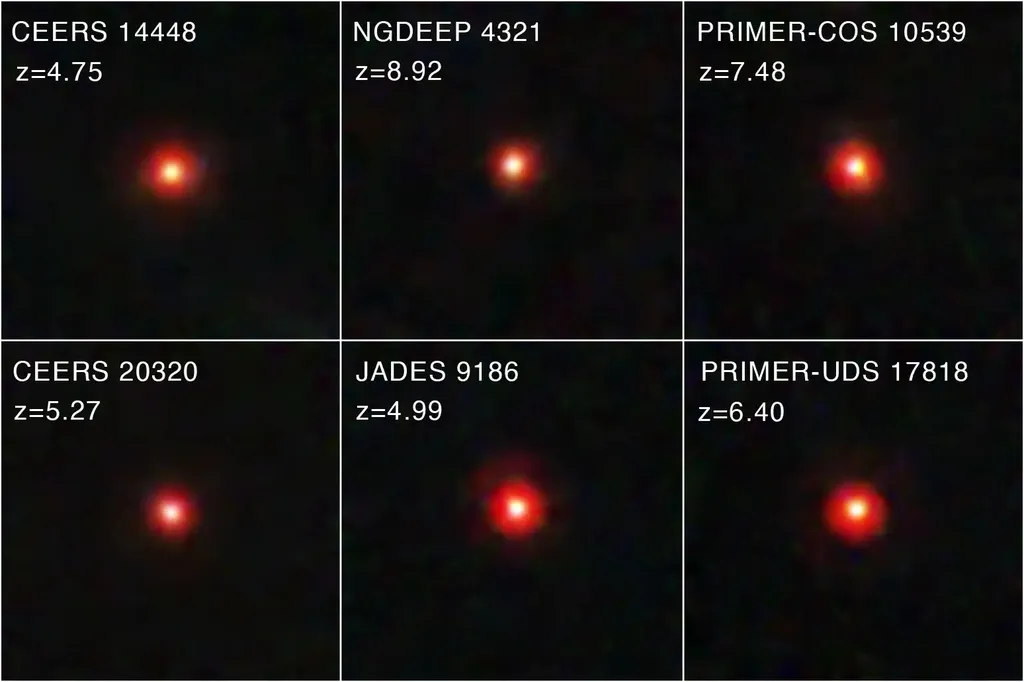
In the vast expanse of the cosmos, a new celestial phenomenon has caught the attention of astronomers. Known as Little Red Dots (LRDs), these enigmatic objects have been the subject of a recent review by researchers Kohei Inayoshi from the National Astronomical Observatory of Japan and Luis C. Ho from The Kavli Institute for Astronomy and Astrophysics at Peking University. Their work, published in the journal Nature Astronomy, sheds light on the nature of these objects and their potential implications for our understanding of the early universe and black hole formation.
The researchers have identified several key characteristics of LRDs. Firstly, they exhibit broad-line emission, a telltale sign of mass accretion onto black holes with masses ranging from one million to ten million times that of our Sun. This suggests that active galactic nuclei (AGN) activity is likely the source of their dominant red optical emission. However, the researchers caution that while stellar components can also contribute to the continuum energetics through dusty star formation, the required stellar mass would be too large to align with other observed LRD properties. Therefore, a purely stellar origin is unlikely to be the dominant power source, although star formation may still contribute to the ultraviolet emission.
One of the most intriguing aspects of LRDs is the coexistence of broad-line emission with Balmer absorption and break features in their spectra. These features cannot be explained by stellar populations alone, suggesting that the nuclear black holes are enshrouded by dense gas with a high covering fraction. This gas-enshrouded environment can produce red optical spectra without requiring dust reddening, through a combination of gas attenuation and thermal self-emission with an effective temperature of around 5000 Kelvin. This also accounts for the flat infrared continuum observed in LRDs.
The researchers propose that LRDs represent a transient phase in early black hole growth, possibly the first accretion episodes of newborn black holes. This hypothesis is supported by the spectral features and redshift evolution of these objects. To further test these models, the researchers suggest investigating time variability, ionizing sources, post-LRD objects, and low-redshift analogs.
While this research may seem far removed from the energy industry, understanding the formation and evolution of black holes and galaxies can provide valuable insights into the fundamental processes that govern the universe. Moreover, the advanced observational techniques and data analysis methods developed for astrophysical research can often find applications in other fields, including energy research. For instance, the study of high-energy phenomena in space can inform the development of nuclear fusion technologies, while the analysis of complex data sets can aid in the optimization of energy systems and the prediction of energy demand. Therefore, while the direct practical applications of this research for the energy sector may not be immediately apparent, the pursuit of fundamental scientific knowledge can often lead to unexpected and transformative technological advancements.
This article is based on research available at arXiv.