
In the realm of energy research, understanding the behavior of complex systems can lead to innovative solutions for efficiency and sustainability. A recent study by Magnus F Ivarsen, a researcher in the field of active matter physics, sheds light on a novel phase transition that could have implications for the energy sector.
Magnus F Ivarsen, affiliated with the University of Cambridge, has identified a thermodynamic phase transition in chiral active matter. This research, published in the journal Physical Review Letters, explores the behavior of systems composed of self-driven particles that exhibit chirality, or handedness, such as certain types of bacteria, synthetic microswimmers, or even some energy-harvesting materials.
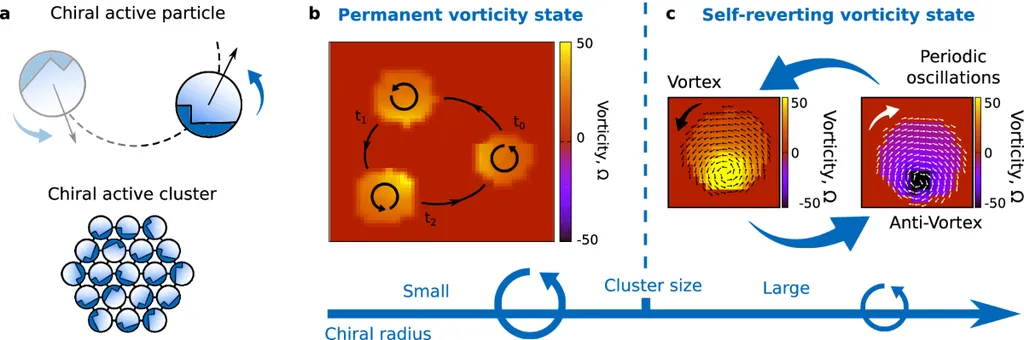
The study reveals that when subjected to low-frequency disorder, these systems can undergo global synchronization and energy dissipation. This means that under certain conditions, the particles can align and move in unison, potentially leading to more efficient energy transfer within the system. Conversely, high-frequency disorder can activate a topological heat pump, generating an inverse energy cascade. This process drives the system towards an Onsager dipole, a state characterized by a pair of vortices with opposite chirality.
One of the most intriguing findings is the possibility of arresting the system into a metastable vortex glass if the dispersion within the system is insufficient to overcome the defect lattice. This vortex glass state could have practical applications in energy storage and transfer, as it represents a stable configuration that can maintain energy for extended periods.
The research proposes a new universality class called topological gas dynamics, which is governed by the interplay of active disorder and topological sorting. This universality class unifies active swarms and classical inviscid fluids, providing a framework for understanding a wide range of systems in the energy sector.
The implications for the energy industry are significant. Understanding and controlling these phase transitions could lead to the development of more efficient energy-harvesting devices, improved energy storage solutions, and better management of energy transfer within complex systems. As the world seeks sustainable and renewable energy solutions, insights from this research could contribute to the development of innovative technologies that harness the unique properties of chiral active matter.
In summary, Magnus F Ivarsen’s research on Onsager condensation in chiral active matter offers valuable insights into the behavior of complex systems. By identifying a new phase transition and proposing a universality class, this study paves the way for potential advancements in the energy sector, particularly in areas related to energy harvesting, storage, and transfer. The findings, published in Physical Review Letters, highlight the importance of understanding the fundamental principles governing active matter and their practical applications in the energy industry.
This article is based on research available at arXiv.