
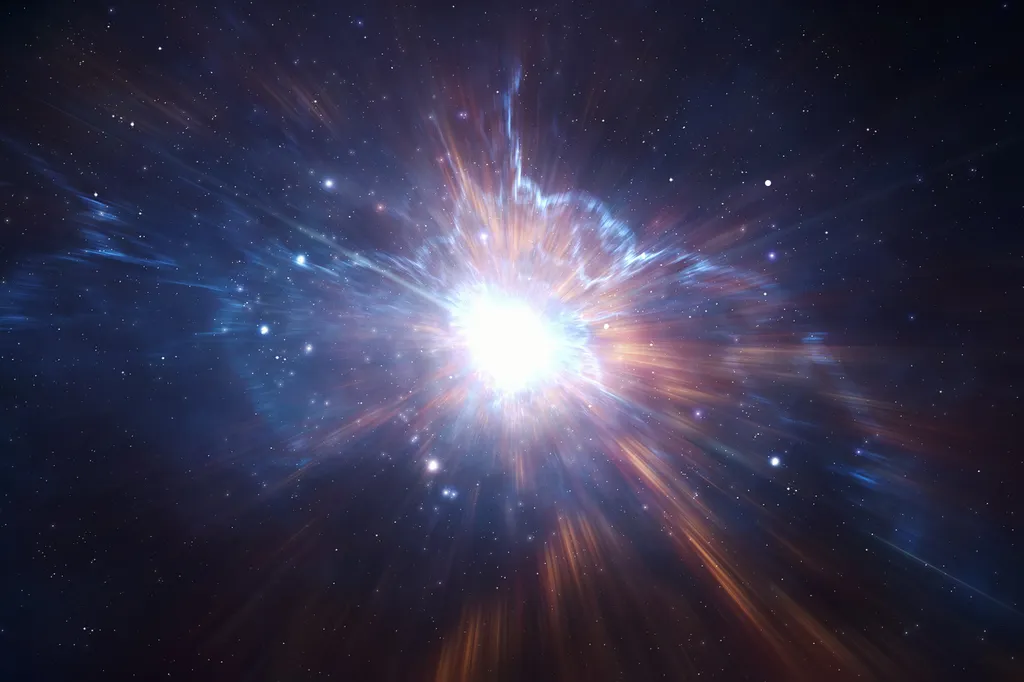
In the realm of astrophysics and energy research, a team of scientists from various institutions, including the Indian Institute of Technology Bombay, the Indian Institute of Astrophysics, and the California Institute of Technology, have made significant observations regarding a powerful gamma-ray burst (GRB). Their findings, published in the journal Astronomy & Astrophysics, shed light on the nature of these cosmic events and their potential implications for our understanding of energy dynamics in the universe.
Gamma-ray bursts are among the most energetic events known to occur in the universe. They release an enormous amount of energy in a very short time, often outshining entire galaxies. The recent study focuses on GRB 230204B, a particularly bright and energetic gamma-ray burst. The researchers conducted a comprehensive multi-wavelength analysis, examining both the prompt emission (the initial burst of gamma rays) and the afterglow (the lingering emission at longer wavelengths).
The GROWTH-India Telescope played a crucial role in this research, discovering a bright afterglow that faded rapidly. The prompt emission of GRB 230204B was found to be highly energetic, with an isotropic equivalent energy emission of approximately 2.2 x 10^54 erg. This emission exhibited strong thermal photospheric components, along with a non-thermal high-energy component. The evolution of these components was consistent with theoretical expectations, providing valuable insights into the physics of gamma-ray bursts.
The afterglow modeling revealed an energetic jet with a total energy of at least 10^52 erg, expanding into a wind-type medium. The observations suggest that the burst was viewed nearly on-axis, indicating a massive star progenitor with strong winds. This finding supports the theory that some gamma-ray bursts are associated with the collapse of massive stars, leading to the formation of black holes or neutron stars.
The study also explored correlations between the prompt emission and the afterglow, aiming to understand the complete picture of GRB progenitors. These correlations can help researchers predict the behavior of future gamma-ray bursts and understand the underlying physical processes.
For the energy sector, the study of gamma-ray bursts offers several practical applications. Understanding the mechanisms behind these powerful cosmic events can provide insights into energy generation and transfer on a massive scale. Additionally, the techniques developed for analyzing gamma-ray bursts can be adapted for use in other areas of energy research, such as nuclear fusion and high-energy physics.
In conclusion, the research on GRB 230204B represents a significant step forward in our understanding of gamma-ray bursts and their progenitors. The findings have important implications for the energy sector, offering new avenues for exploration and innovation. As the researchers continue to unravel the mysteries of these cosmic phenomena, we can expect to see further advancements in our understanding of energy dynamics in the universe.
Source: Astronomy & Astrophysics
This article is based on research available at arXiv.