
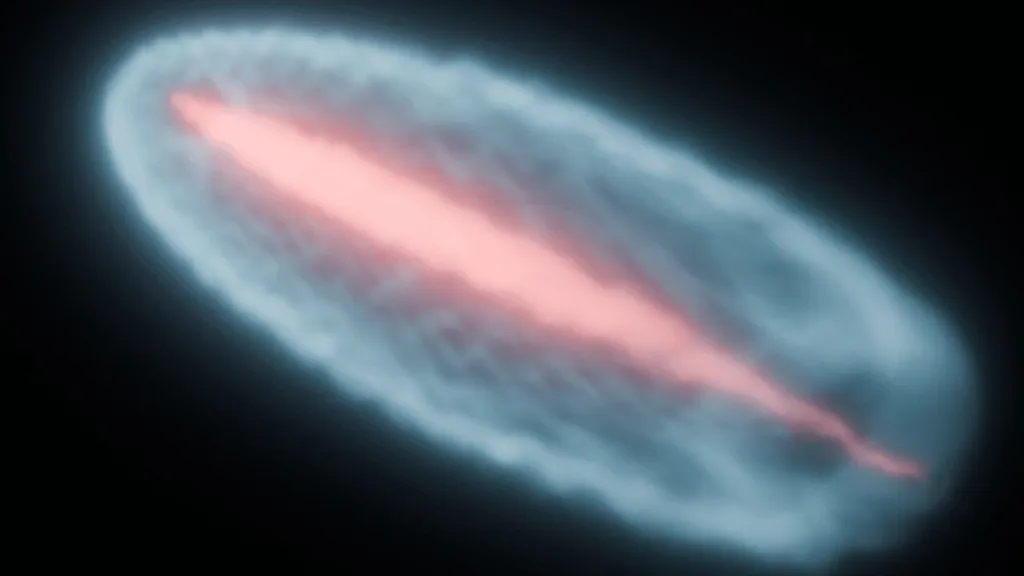
In the realm of astrophysics and energy research, Dr. She-Sheng Xue, a researcher at the Institute of High Energy Physics, Chinese Academy of Sciences, has been exploring the intriguing dynamics of photon and particle interactions around black holes. His recent study, published in the journal Physical Review D, delves into the phenomenon of ultra-high-energy (UHE) particle production in the vicinity of black holes, offering insights that could have implications for our understanding of energy processes in the universe.
Dr. Xue’s research focuses on the Compton-rocket effect, a process where multiple photons interact with electrons in a dense, opaque fireball of photons and electron-positron pairs. This fireball, with a temperature significantly higher than the electron mass, is theorized to exist in the central engine of gamma-ray bursts, a type of highly energetic explosion observed in distant galaxies. The inner part of this fireball is thought to inflow and form a gravitationally trapped halo, or “fireshell,” around a black hole.
Within this fireshell, Dr. Xue’s study reveals that charged particles can be accelerated through an avalanche runaway process, leading to a non-trivial probability of UHE electrons and protons. These UHE particles subsequently produce very-high-energy (VHE) photons and neutrinos. The fireshell, described as a metastable structure, cools over time through the emission of UHE particles and blackbody radiation. The study calculates the UHE particle luminosity, showing how it varies with time, and discusses the unique features of the produced UHE particles.
The practical applications of this research for the energy sector are not immediate, as the phenomena studied are extreme and occur in astrophysical environments far removed from Earth. However, understanding these fundamental processes can contribute to our broader knowledge of particle acceleration and energy production in the universe. This knowledge could potentially inspire new ideas for energy generation or particle acceleration technologies in the future. Moreover, the study’s findings could aid in the interpretation of data from high-energy astrophysical observations, enhancing our ability to probe the universe’s most energetic events.
Dr. Xue’s work highlights the complex interplay of photons and particles in the extreme environments around black holes, offering a glimpse into the dynamic and energetic processes that shape our universe. As we continue to explore these phenomena, we deepen our understanding of the fundamental laws of physics and their applications, both in the cosmos and here on Earth.
The research was published in Physical Review D, a peer-reviewed scientific journal published by the American Physical Society.
This article is based on research available at arXiv.