
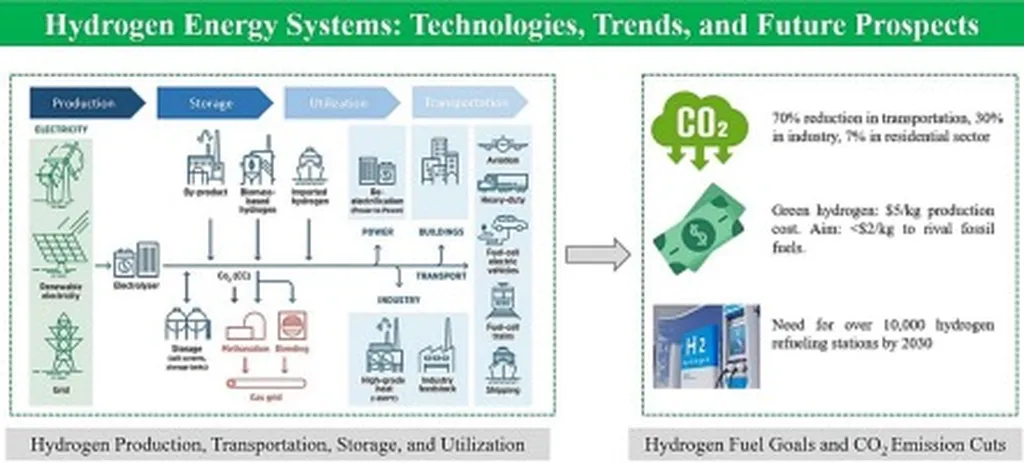
Researchers Abdullah Shahin, Hannes Gernandt, Anton Plietzsch, and Johannes Schiffer from the University of Stuttgart have developed a new modeling approach for integrated hydrogen systems. Their work, published in the journal “IEEE Transactions on Control Systems Technology,” aims to address the unique challenges posed by hydrogen in the energy sector.
As hydrogen gains traction as a key player in the shift towards climate-neutral energy systems, there’s a pressing need for modeling frameworks that can accurately capture its distinct properties. Existing gas network models, primarily designed for natural gas, fall short in this regard, particularly when it comes to the interplay between hydrogen pipes, electrolyzers, fuel cells, and electrically driven compressors.
The researchers propose a unified, systematic port-Hamiltonian (pH) framework to model hydrogen systems. This approach inherently provides a passive input-output map of the overall interconnected system. This means it can help ensure the system remains stable and efficient under various operating conditions.
The pH framework offers a promising foundation for structured analysis, control, and optimization of hydrogen energy systems. By providing a clear, unified model, it can aid in the design and management of these complex systems, ultimately facilitating the integration of hydrogen into our energy infrastructure.
For the energy industry, this research could lead to more efficient and reliable hydrogen-based power systems. It could also pave the way for better control strategies and optimization techniques, making hydrogen a more viable and attractive option in the pursuit of climate-neutral energy systems.
This article is based on research available at arXiv.