
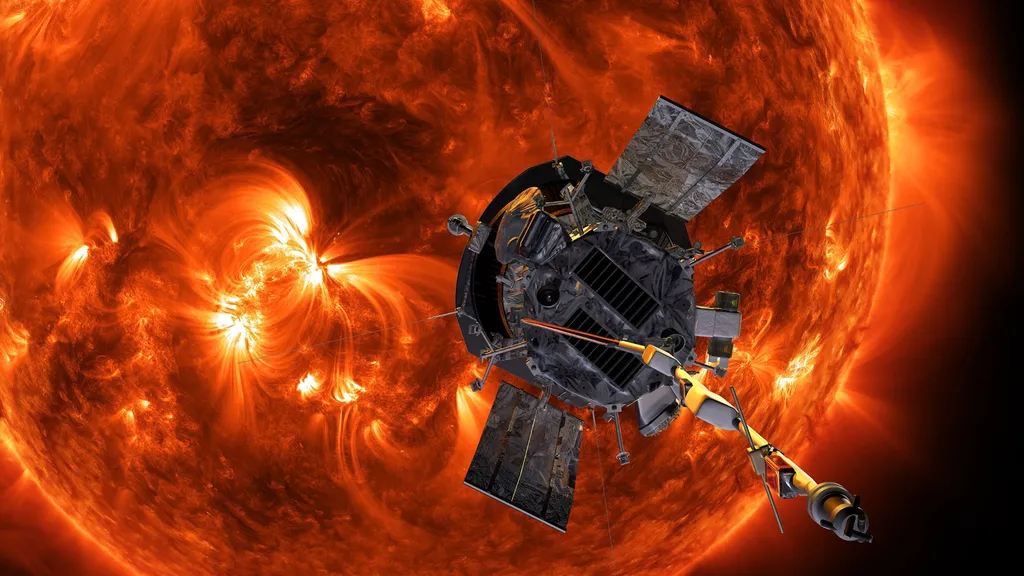
In the realm of energy journalism, few topics are as captivating as the exploration of our solar system’s dynamic environment. Today, we delve into the recent findings from a team of researchers led by Naïs Fargette from Imperial College London, who have been scrutinizing data from NASA’s Parker Solar Probe (PSP) mission. This international team, including scientists from the UK, USA, and Italy, has been investigating the properties of the heliospheric current sheet (HCS), a vast structure in the Sun’s outer atmosphere, known as the heliosphere. Their work was recently published in the journal Nature Astronomy.
The heliospheric current sheet is a vast, dynamic structure that originates from the Sun’s equatorial region and extends throughout the heliosphere. It is a boundary where the magnetic field of the Sun changes direction, and it plays a crucial role in shaping the solar wind and the overall space weather environment. The Parker Solar Probe, launched in 2018, is on a mission to study the Sun’s outer atmosphere and solar wind more closely than any other spacecraft before it. This provides a unique opportunity to understand the properties of the HCS near the Sun.
The research team identified 39 HCS crossings measured by PSP below 50 solar radii during encounters 6 to 21. They found that 82% of these crossings exhibited signatures of magnetic reconnection jets. Magnetic reconnection is a process where magnetic field lines break and reconnect, releasing vast amounts of energy. This process is known to accelerate particles to high speeds, creating jets of plasma. The team observed that the proportion of inward and outward jets depends on the heliocentric distance, with the main HCS reconnection X-line (the line where reconnection occurs) having a higher probability of being located close to the Alfvén surface, a boundary where the solar wind’s speed equals the Alfvén speed (the speed at which disturbances propagate in a magnetized plasma).
Interestingly, the researchers noted a radial asymmetry in jet acceleration. Inward jets did not reach the local Alfvén speed, whereas outward jets did. This asymmetry could have implications for our understanding of particle acceleration mechanisms in the heliosphere.
The team also found that turbulence levels were enhanced in the ion kinetic range within the HCS. Turbulence is a ubiquitous feature of the solar wind and plays a crucial role in the dissipation of energy and the heating of the solar wind plasma. The enhanced turbulence levels observed in the HCS suggest that magnetic reconnection might trigger an inverse cascade, a process where energy is transferred from small to large scales.
Lastly, the researchers highlighted the ubiquity of magnetic hole trains in the high beta environment of the HCS. Beta is the ratio of plasma pressure to magnetic pressure. Magnetic holes are regions of reduced magnetic field strength and are often associated with the mirror mode instability, a type of plasma instability that can regulate the ion temperature anisotropy (the difference in temperature between ions moving parallel and perpendicular to the magnetic field).
The findings of this research shed new light on the properties of magnetic reconnection in the high beta plasma environment of the HCS, its interplay with the turbulent cascade, and the role of the mirror mode instability. Understanding these processes is crucial for predicting space weather events, which can have significant impacts on space-based and ground-based technological systems, including power grids, communication systems, and satellites. Moreover, insights into magnetic reconnection and turbulence in the solar wind can help improve our understanding of similar processes in other astrophysical plasmas and laboratory experiments.
As we continue to explore the mysteries of our solar system, research like this brings us one step closer to unraveling the complex dynamics of the Sun and its influence on the space environment. The practical applications of this research for the energy sector include improving space weather forecasting, which can help protect critical infrastructure and ensure the reliable operation of energy systems. Additionally, understanding the fundamental processes of magnetic reconnection and turbulence can inform the development of fusion energy technologies, which aim to harness the power of the Sun here on Earth.
In conclusion, the work of Fargette and her colleagues provides valuable insights into the behavior of the heliospheric current sheet and its role in shaping the solar wind and space weather environment. As we continue to explore the mysteries of our solar system, research like this brings us one step closer to unraveling the complex dynamics of the Sun and its influence on the space environment. The practical applications of this research for the energy sector are significant and far-reaching, highlighting the importance of continued investment in space exploration and scientific research.
This article is based on research available at arXiv.