
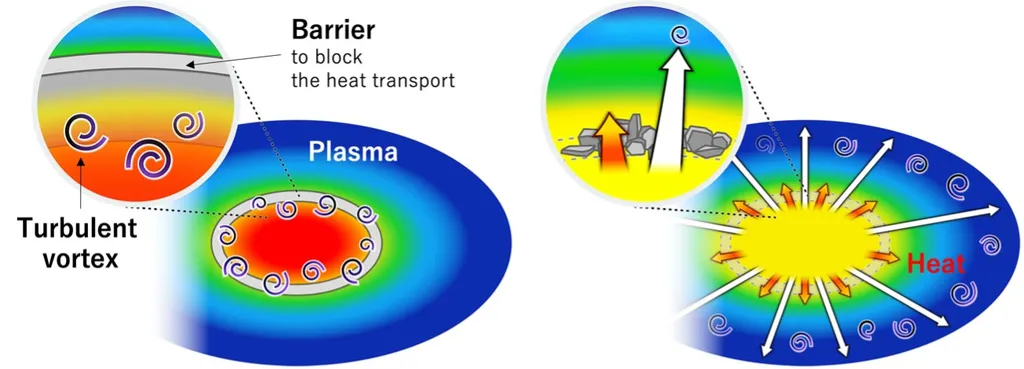
Researchers from the National Institutes for Quantum Science and Technology (QST) in Japan, T. Kato, H. Sugama, and M. Honda, have recently published a study that explores the effects of turbulent energy exchange between electrons and ions on global temperature profiles in fusion plasmas. Their work, titled “Effects of Turbulent Energy Exchange between Electrons and Ions on Global Temperature Profiles,” was published in the journal Physical Review Letters.
The study builds upon previous local gyrokinetic studies that demonstrated turbulent energy exchange can surpass collisional exchange in weakly collisional plasmas. Specifically, ion temperature gradient (ITG) turbulence can impede ion heating by alpha-heated electrons, while trapped electron mode (TEM) turbulence transfers energy from electrons to ions, enhancing ion heating.
The researchers extended these findings by examining the impact of turbulent energy exchange on global temperature profiles at steady state using the one-dimensional transport solver GOTRESS. They analyzed several scenarios, including a DIII-D discharge and enhanced electron heating in a DIII-D like tokamak plasma. In the latter case, they found that energy transfer from hot electrons to cold ions driven by TEM turbulence became comparable to or exceeded the collisional contribution, significantly increasing the ion temperature profile.
For future fusion reactors like ITER Baseline and SPARC standard H-mode scenarios, the study found that turbulent energy exchange is largely compensated by collisional exchange, resulting in minimal effects on temperature profiles. However, the researchers noted that turbulent energy exchange could become significant during plasma start-up phases where heating power is strongly unbalanced between electrons and ions.
The practical implications for the energy sector, particularly in fusion energy development, are notable. Understanding and managing turbulent energy exchange could lead to more efficient plasma heating and better control of temperature profiles in fusion reactors. This could potentially accelerate the development of sustainable and clean fusion energy, contributing to a low-carbon energy future. The research was published in Physical Review Letters.
This article is based on research available at arXiv.