
Researchers from the University of Hamburg, the University of Alabama in Huntsville, Stanford University, and the University of Science and Technology of China have collaborated on a study to understand the impact of the Sun’s magnetic field on the production of gamma rays. Their work, published in the journal Astronomy & Astrophysics, sheds light on the complex interactions between cosmic rays and the solar atmosphere, which has practical implications for space weather forecasting and the energy sector.
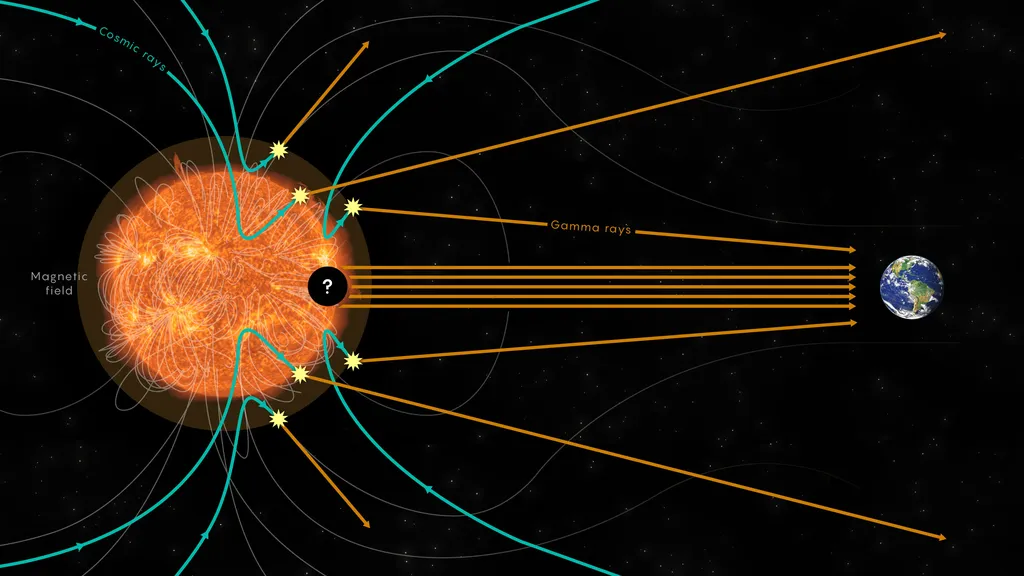
The Sun constantly emits high-energy gamma rays, primarily due to the interaction of galactic cosmic rays (GCRs) with its atmosphere. Previous observations by the Fermi Large Area Telescope (Fermi-LAT) and the High-Altitude Water Cherenkov (HAWC) observatory have detected a gamma-ray flux that is higher than early theoretical predictions. Moreover, these observations have revealed unexpected temporal and spectral features, suggesting that the Sun’s magnetic field plays a crucial role in this process.
To investigate this phenomenon, the researchers used the CRPropa framework to model GCR-induced gamma-ray emission at the solar disk. They incorporated realistic hadronic interactions, chromospheric density profiles, and various magnetic field configurations over the solar cycle. This approach allowed them to quantify the gamma-ray emission of the entire solar disk for different phases of solar activity and produce, for the first time, maps of gamma-ray production locations on the solar surface.
The study considered both mono-energetic and realistic power-law injection spectra in a simplified dipole-quadrupole current sheet model and potential-field source surface (PFSS) extrapolations for Carrington rotations during solar maximum and minimum. The results indicate that magnetic mirroring and large-scale field topology significantly influence the spectral shape and spatial distribution of the emission. Interestingly, the simulations predict slightly enhanced fluxes at solar minimum.
While the simulated baseline fluxes remain below observational values, the researchers suggest that additional effects, such as the inclusion of heavier nuclei, Parker-field mirroring, and deeper atmospheric interactions, could further enhance the fluxes to match observational data. Furthermore, the study highlights that hadronic interactions not only produce gamma rays but also neutrinos. Based on their gamma-ray predictions, the researchers estimated the expected neutrino flux from the Sun, finding that it is slightly below current upper limits from the IceCube Neutrino Observatory.
This research provides valuable insights into the complex interplay between cosmic rays and the solar atmosphere, with practical applications for space weather forecasting and the energy sector. Understanding these processes can help improve predictions of solar activity and its impact on Earth’s technological infrastructure, including power grids and satellite communications.
Source: Astronomy & Astrophysics
This article is based on research available at arXiv.