
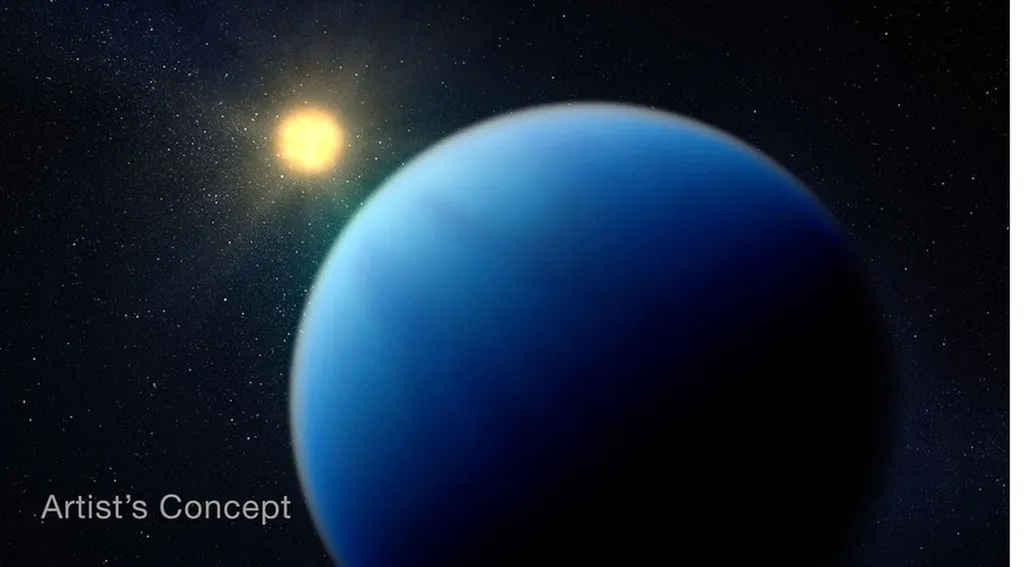
In a recent study, a team of researchers led by Caroline Piaulet-Ghorayeb from the University of Maryland, along with collaborators from various institutions, has shed new light on the composition of sub-Neptune exoplanets. These planets, which are the most common type of planet in our galaxy, have envelopes that may not be as fully mixed as previously thought.
The team developed a new framework called ATHENAIA to better understand the potential for water and hydrogen to separate, or demix, in the envelopes of warm sub-Neptunes. They focused on the planet TOI-270 d, which has an equilibrium temperature of about 350 K (approximately 77°C or 170°F). By combining radiative-convective atmosphere models with interior models, they found that the higher temperatures at which hydrogen and water demix in water-rich environments, along with the shallower adiabatic gradients of these envelopes, create conditions that favor demixing.
This demixing process is more likely to occur on more massive and colder planets, but it can still affect warm, metal-rich sub-Neptunes with temperatures ranging from 330 to 500 K. The researchers suggest that current methods for estimating the bulk envelope metallicities and mass fractions of these planets may be underestimating these values if they assume fully-miscible envelopes.
Furthermore, their modeling of TOI-270 d’s envelope and interior revealed that, for a typical internal energy budget, the boundary conditions between the envelope and the mantle likely prevent the presence of a molten magma ocean. This finding challenges the current paradigm for linking sub-Neptune atmospheres to their interiors and highlights the need for further evolutionary modeling to describe the onset of metallicity gradients in sub-Neptune envelopes.
This research was published in the journal Nature Astronomy, and it encourages a reconsideration of how we understand the composition and structure of sub-Neptune exoplanets. While this study is focused on exoplanets, the insights gained could potentially influence our understanding of planetary formation and evolution more broadly, including within our own solar system. For the energy sector, a better understanding of planetary compositions and structures can inform models of planetary formation and evolution, which in turn can help guide the search for habitable exoplanets and potential resources for future space exploration and energy production.
This article is based on research available at arXiv.