
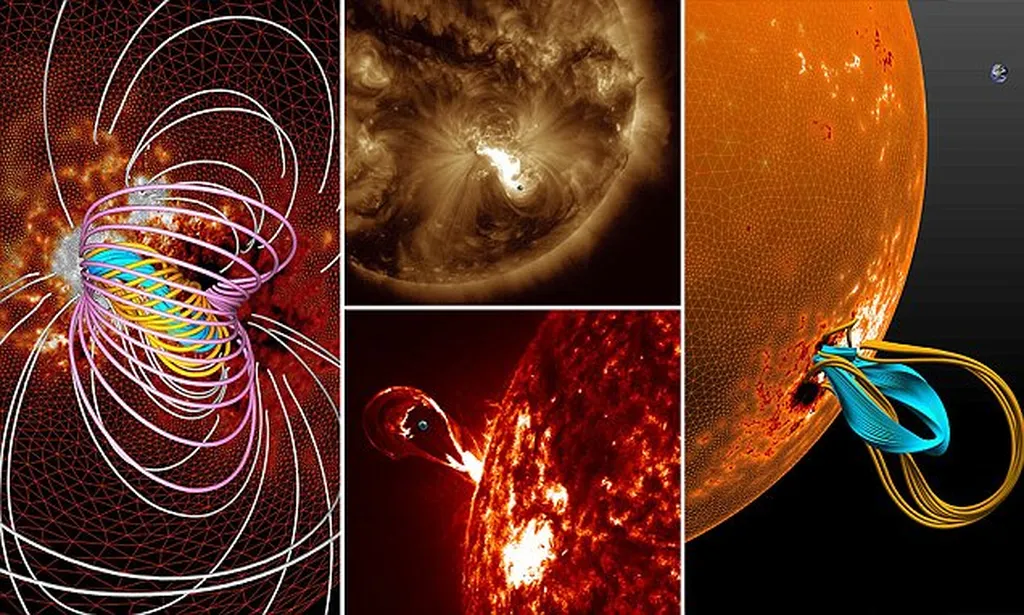
In the realm of solar physics, understanding the behavior of active regions on the sun’s surface is crucial for predicting space weather events that can impact Earth’s technology infrastructure, including energy systems. Researchers from the Leibniz Institute for Solar Physics (KIS) in Germany, including Carsten Denker, Robert Kamlah, Meetu Verma, and Alexander G. M. Pietrow, have recently published a study that sheds light on the conditions leading up to a significant solar flare.
The study, published in the journal Astronomy & Astrophysics, focuses on active region NOAA 14274, which produced some of the strongest solar flares of Solar Cycle 25. The researchers utilized the improved High-resolution Fast Imager (HiFI+) at the 1.5-meter GREGOR solar telescope in Tenerife, Spain, to capture a detailed mosaic of the active region approximately 30 minutes before the onset of an X1.2 flare on November 10, 2025.
The observations revealed several key features of the active region that contributed to its high flare productivity. Notably, the researchers identified strongly curved penumbral filaments, sunspot rotation, and shear motions along the polarity inversion line (PIL). These dynamic processes led to a highly stressed magnetic field configuration, which stored sufficient energy to release multiple M- and X-class flares.
One of the significant findings of the study is the identification of small-scale brightenings that appeared as precursors to the flare. These brightenings, each with a width of a few tenths of an arcsecond, traced penumbral filaments in the trailing sunspot. Understanding these precursor events is vital for improving the prediction of solar flares, which can disrupt satellite communications, GPS systems, and power grids on Earth.
For the energy sector, this research underscores the importance of monitoring solar activity to mitigate potential impacts on energy infrastructure. Solar flares can induce geomagnetic disturbances that may affect power transmission lines and transformers, leading to voltage fluctuations and, in extreme cases, blackouts. By enhancing our ability to predict solar flares, energy providers can take proactive measures to protect their systems and ensure a stable energy supply.
In summary, the study by Denker and colleagues provides valuable insights into the magnetic field dynamics that precede major solar flares. These findings contribute to the ongoing efforts to improve space weather forecasting and, consequently, help the energy industry prepare for and mitigate the impacts of solar storms.
This article is based on research available at arXiv.