
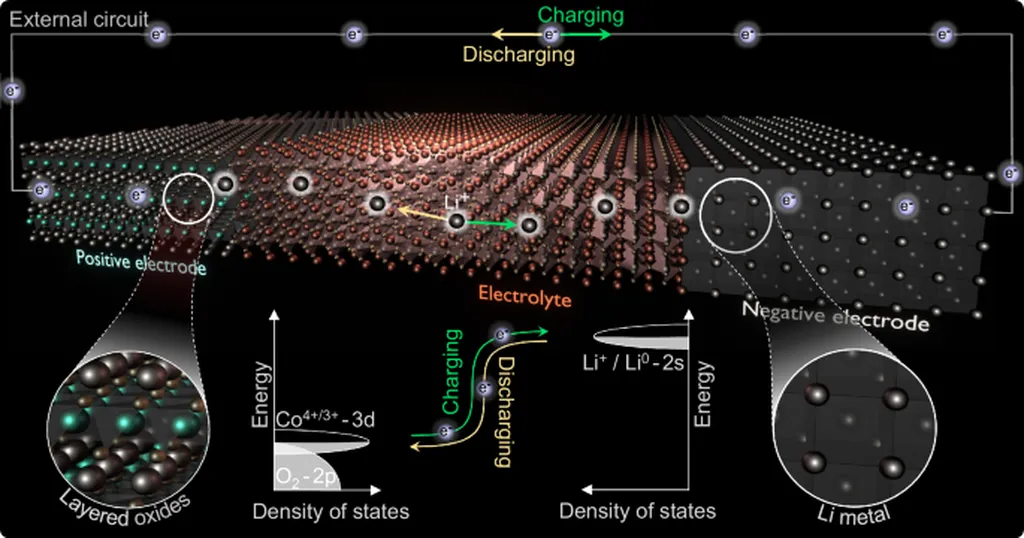
In the realm of energy storage, lithium-ion batteries have become indispensable, powering everything from electric vehicles to portable electronics. As the demand for these batteries continues to surge, so does the need for advanced diagnostic tools to ensure their quality, predict their aging, and facilitate recycling. A team of researchers from the University of Oxford, the University of Cologne, and the University of Warwick has developed a novel approach to address these challenges. Led by Dr. William Evans and Professor Peter Krüger, the team has pioneered a method for magnetic imaging of current densities in lithium-ion batteries, offering a powerful new tool for the energy sector.
The researchers employed optically pumped magnetometers (OPMs) to perform real-time imaging of internal dynamics in battery cells. This quantum-magnetometry method allows for non-invasive, high-resolution monitoring of electrochemical processes. The team demonstrated the effectiveness of this approach by tracking relaxation processes in 6000 mA h lithium-ion cells following pulsed discharges. They varied the pulse durations, currents, and states of charge to thoroughly test the method’s capabilities.
To validate their findings, the researchers benchmarked their results against superconducting-quantum-interference-device (SQUID) magnetometry and conducted three-dimensional finite element simulations. They also used equivalent circuit models to interpret the relaxation profiles, revealing spatially resolved features and transient magnetic-field signatures that were previously inaccessible with non-invasive techniques like electrochemical impedance spectroscopy (EIS).
The practical applications of this research are significant for the energy industry. The OPM-based magnetic imaging method can be instrumental in cell development, manufacturing quality assurance, and second-life assessment of lithium-ion batteries. By providing detailed insights into the internal dynamics of batteries, this diagnostic tool can help improve battery performance, extend their lifespan, and enhance recycling processes. The research was published in the journal Nature Communications, offering a promising advancement in the field of energy storage and battery technology.
This article is based on research available at arXiv.