
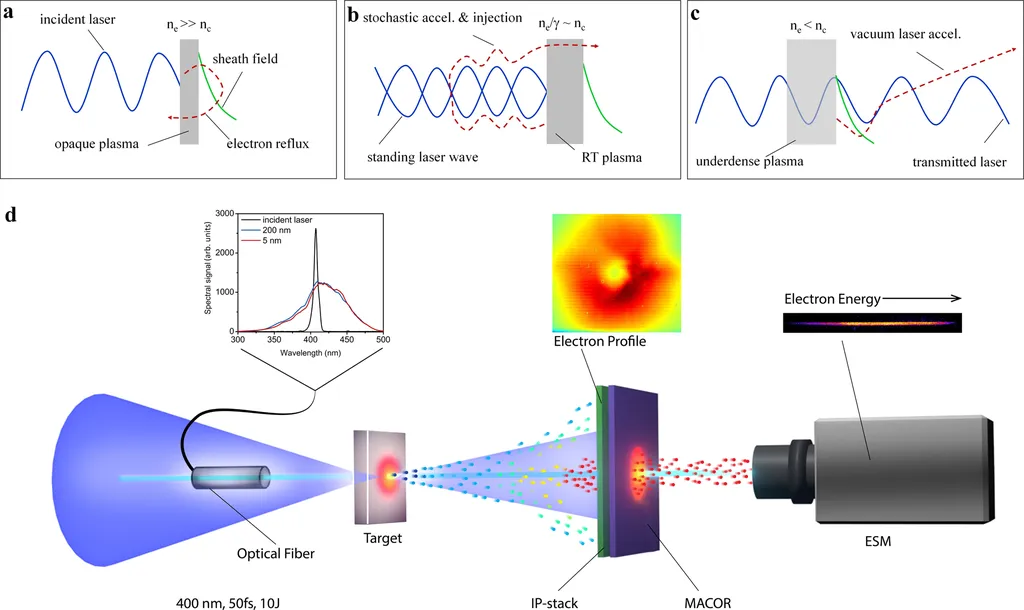
In the realm of energy research, a team of scientists from the Helmholtz-Zentrum Dresden-Rossendorf (HZDR) in Germany has been exploring innovative methods to enhance electron acceleration using laser pulses. The researchers, led by Dr. P. Hadjisolomou, have recently published their findings in the journal Physical Review Letters, shedding light on the potential of radially polarized laser pulses in plasma channels for more efficient electron injection and acceleration.
The study focuses on the interaction between ultraintense laser pulses and narrow plasma channels. By employing three-dimensional particle-in-cell simulations, the team investigated how different polarization and focusing geometries of laser beams affect electron dynamics. They compared a linearly polarized laser beam with two radially polarized cases: one focused more tightly to match peak intensity, and another at equal focusing to isolate the effects of polarization.
The results revealed that radially polarized beams significantly enhance electron release from the channel walls, leading to improved injection rates. Specifically, the radially polarized case with equal focusing injected approximately one-third more charge than the linearly polarized case. Moreover, the tightly focused radially polarized case achieved about twice the maximum electron energy compared to the linearly polarized beam.
These findings underscore the importance of polarization and focusing geometry in optimizing laser-driven electron acceleration setups. For the energy sector, this research could pave the way for more efficient and compact particle accelerators, which have applications in various fields such as medical imaging, cancer therapy, and industrial radiography. Additionally, improved electron acceleration techniques could enhance the performance of laser-driven fusion energy concepts, contributing to the development of clean and sustainable energy sources.
The research was published in the journal Physical Review Letters, a prestigious publication in the field of physics, highlighting the significance of these findings for the scientific community and the energy industry. As the quest for advanced energy solutions continues, such innovations in laser-plasma interactions hold promise for revolutionizing particle acceleration technologies.
This article is based on research available at arXiv.