
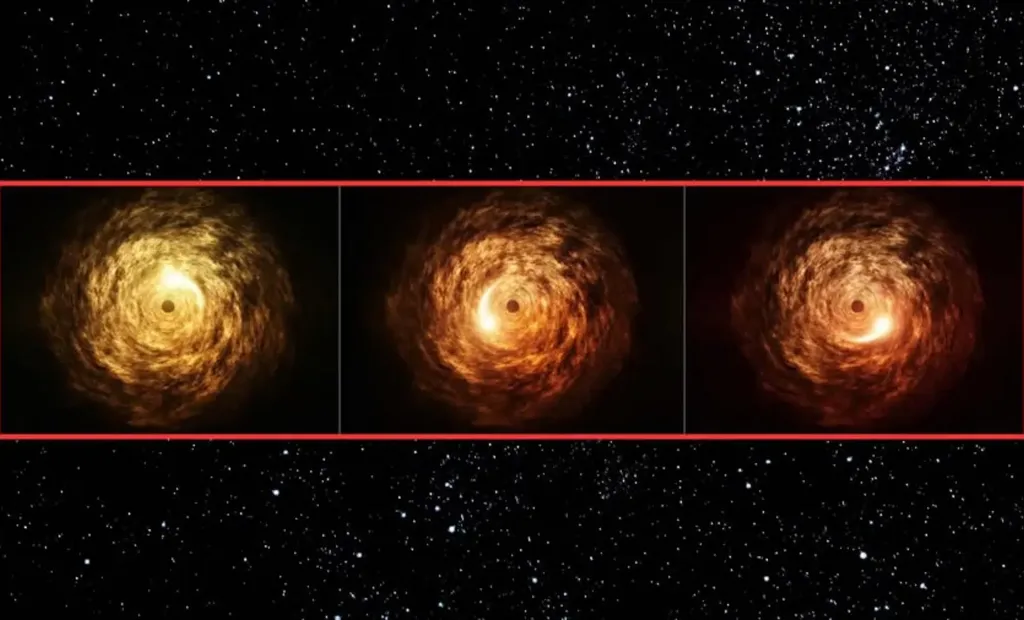
In a recent study published in the Astrophysical Journal, researchers from the University of California, Santa Cruz, led by Wen-Han Zhou, have shed new light on the mysterious flares observed around Sgr A*, the supermassive black hole at the center of our Milky Way galaxy. The team, including Yun Zhang, Jiamu Huang, and Douglas N. C. Lin, has explored the role of small planetary bodies in generating these flares, refining previous models with insights from recent space missions.
The researchers focused on small planetary bodies that originated from the stellar disk surrounding Sgr A*. They investigated how these bodies, whether they are rubble-pile or monolithic structures, can be tidally disrupted and fragmented as they approach the black hole. By incorporating material strength constraints and evaluating the evaporation dynamics of the resulting fragments, the team estimated the survivability of these fragments under aerodynamic heating and computed their expected luminosity from ablation.
The study found that planetary fragments can approach as close as 8 gravitational radii to the black hole, consistent with observed flare locations. The fireball model developed by the researchers yielded luminosities ranging from 1e34 to 1e36 erg/s for fragments originating from parent bodies a few kilometers in size. The derived flare frequency versus luminosity distribution followed a power law with an index of 1.83, which aligns well with observed values ranging from 1.65 to 1.9. Additionally, the flare duration was found to scale as L^(-1/3), consistent with observations.
The researchers considered the young stars around Sgr A* as the potential planetary reservoir. They demonstrated that a small-body population analogous in mass to the primordial Kuiper belt, combined with the common existence of close-in super-Earths and long-period Neptunes, could supply the observed flares. This study provides a plausible explanation for the frequent short-duration flares around Sgr A* and offers insights into the dynamics of small planetary bodies in the vicinity of supermassive black holes.
While this research is primarily focused on astrophysical phenomena, the methods and models developed could have broader implications for understanding the behavior of small bodies in extreme environments. In the energy sector, similar principles might be applied to study the interactions of small particles or debris in high-energy systems, such as fusion reactors or advanced propulsion technologies. The insights gained from this study could contribute to the development of more robust and efficient energy systems by better understanding and mitigating the effects of small-scale disruptions and fragmentations.
This article is based on research available at arXiv.