
In the realm of energy research, a team of scientists from Osaka University in Japan has made a significant stride in laser-driven ion acceleration. The researchers, led by Dr. Masakatsu Murakami, have proposed a novel scheme called micronozzle acceleration (MNA) that could potentially revolutionize the way we generate high-energy proton beams.
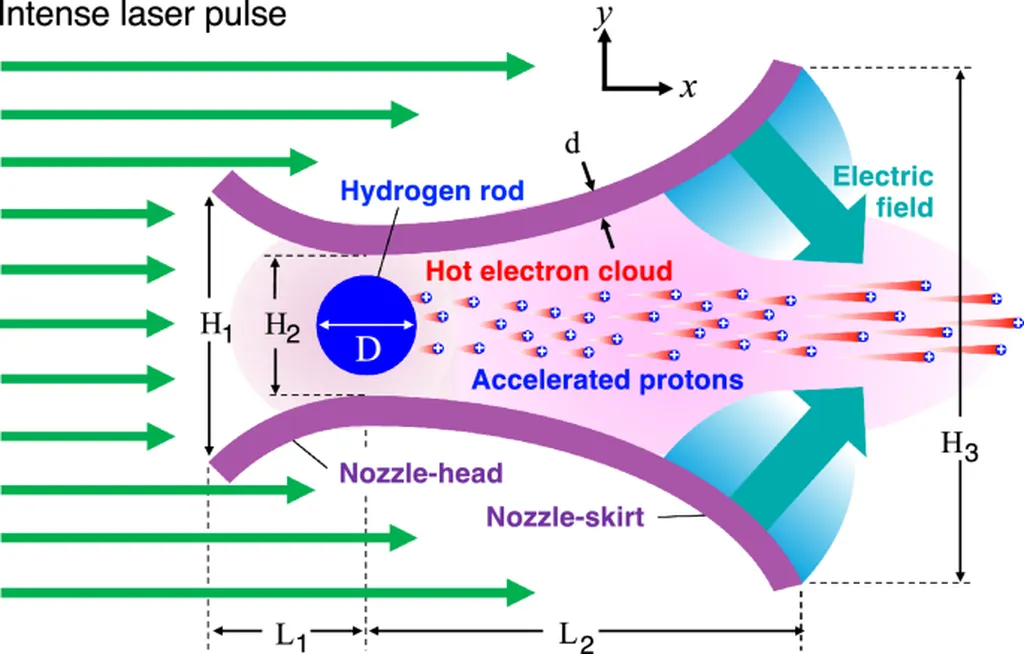
The study, published in the journal Physical Review Letters, explores the underlying physics and performance of MNA through two-dimensional particle-in-cell simulations. The researchers designed a target consisting of a micron-sized hydrogen rod embedded inside a hollow micronozzle. When this target is illuminated by an ultraintense ultrashort laser pulse along its symmetric axis, it generates a strong electrostatic field with a long lifetime and an extensive space around the downstream tail of the nozzle.
This electric field plays a crucial role in amplifying the kinetic energies of the accelerated protons. The researchers found that at a laser intensity of 10^22 W/cm^2, the MNA scheme can generate proton beams with extremely high kinetic energies on the giga-electron-volt (GeV) order. This is a significant achievement, as high-energy proton beams have a wide range of applications in the energy sector, including nuclear fusion research, cancer therapy, and material science.
The practical implications of this research for the energy industry are substantial. High-energy proton beams can be used to initiate nuclear fusion reactions, which could potentially provide a clean and virtually limitless source of energy. Moreover, the ability to generate such high-energy beams with a relatively compact and efficient setup could make this technology more accessible and cost-effective.
In conclusion, the MNA scheme proposed by the researchers at Osaka University represents a significant advancement in the field of laser-driven ion acceleration. The ability to generate high-energy proton beams with a compact and efficient setup has the potential to revolutionize the energy industry and pave the way for new and innovative applications.
This article is based on research available at arXiv.