
In the realm of energy transition and grid management, a team of researchers from McGill University has introduced a novel approach to optimize decision-making in complex systems like remote microgrids. The team, led by Hadi Nekoei and including Alexandre Blondin Massé, Rachid Hassani, Sarath Chandar, and Vincent Mai, has developed a method called Shielded Controller Units (SCUs) to ensure that reinforcement learning (RL) agents respect operational constraints, a critical aspect for real-world applications. Their research was published in the journal Nature Communications.
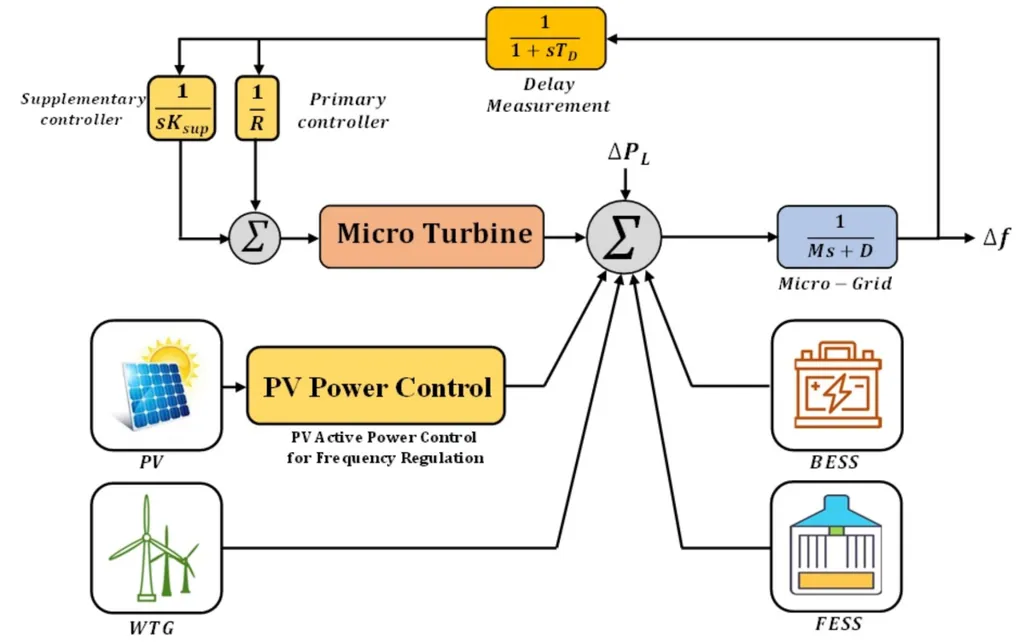
Remote microgrids, which supply power to communities disconnected from the main grid, face unique challenges. These systems must coordinate control of renewable sources like wind turbines, alongside fuel generators and batteries, to meet demand while minimizing fuel consumption and battery degradation. The intermittent nature of renewable energy and varying load conditions make this a complex task, further complicated by extensive regulations and operational constraints.
The researchers’ solution, SCUs, is a systematic and interpretable approach that leverages prior knowledge of system dynamics to ensure constraint satisfaction. The shield synthesis methodology decomposes the environment into a hierarchical structure, with each SCU managing a subset of constraints. This approach provides interpretable guarantees that the RL agent will respect the constraints, making it suitable for real-world deployment.
In a demonstration of their method, the researchers applied SCUs to a remote microgrid optimization task with strict operational requirements. The RL agent, equipped with SCUs, achieved a 24% reduction in fuel consumption without increasing battery degradation, outperforming other baselines while satisfying all constraints. This success highlights the potential of SCUs to contribute to the safe application of RL in the energy sector, particularly in the context of the energy transition.
The practical applications of this research are significant for the energy industry. By enabling more efficient and constraint-respecting control of microgrids, SCUs can help reduce fuel consumption, lower operational costs, and extend the lifespan of battery storage systems. Moreover, the interpretability of SCUs can facilitate regulatory compliance and stakeholder trust, paving the way for broader adoption of RL in energy management systems.
In conclusion, the work of Nekoei and his colleagues presents a promising advancement in the application of reinforcement learning to energy systems. By addressing the critical challenge of constraint satisfaction, SCUs offer a practical tool for optimizing decision-making in complex, real-world energy environments.
This article is based on research available at arXiv.