
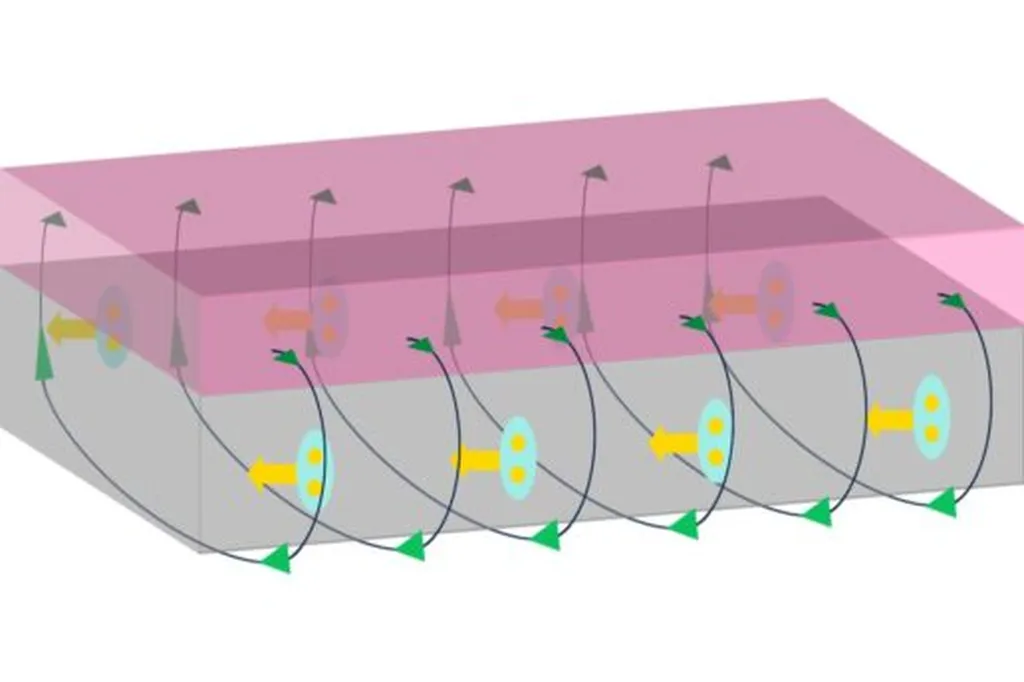
Researchers from the Indian Institute of Technology (IIT) Bombay, including Amartya Pal, Debashish Mondal, Tanay Nag, and Arijit Saha, have proposed a theoretical framework that could advance our understanding of topological superconductivity and the superconducting diode effect (SDE). Their work, published in the journal Physical Review B, offers insights that could potentially lead to more efficient superconducting devices.
The team’s research focuses on a one-dimensional (1D) tight-binding model that incorporates unconventional magnetic order along with Rashba and Ising spin-orbit couplings. These elements are crucial for realizing two key phenomena in condensed matter systems: topological superconductivity and the superconducting diode effect.
Topological superconductivity is a state of matter that could enable fault-tolerant quantum computing due to its robust edge states, known as Majorana modes. The researchers found that by introducing an on-site attractive Hubbard interaction, superconducting order parameters emerge in both conventional Bardeen-Cooper-Schrieffer (BCS) and finite-momentum Fulde-Ferrell-Larkin-Ovchinnikov (FFLO) pairing channels. Both of these pairing states can support topological superconductivity, characterized by a nontrivial winding number, and lead to the emergence of four zero-energy Majorana modes localized at the ends of the 1D chain.
The FFLO state, in particular, gives rise to an intrinsic field-free superconducting diode effect. This effect is manifested as a nonreciprocal supercurrent, meaning the current flows more easily in one direction than the other. The researchers quantified this effect using the diode efficiency, η, and found that their model yields a large diode efficiency of approximately 65%.
For the energy sector, these findings could pave the way for highly efficient superconducting devices. Superconductors are materials that can conduct electricity without resistance, making them highly desirable for energy transmission and storage applications. The superconducting diode effect could be particularly useful in designing more efficient energy conversion and control systems. Additionally, the robust Majorana modes in topological superconductors could find applications in quantum computing, which could revolutionize data processing and optimization in the energy sector.
In summary, the research by Pal, Mondal, Nag, and Saha offers a theoretical framework that could lead to advancements in topological superconductivity and the superconducting diode effect. Their work highlights the potential for more efficient superconducting devices, which could have significant implications for the energy industry. The research was published in Physical Review B, a peer-reviewed journal in the field of condensed matter and materials physics.
This article is based on research available at arXiv.