
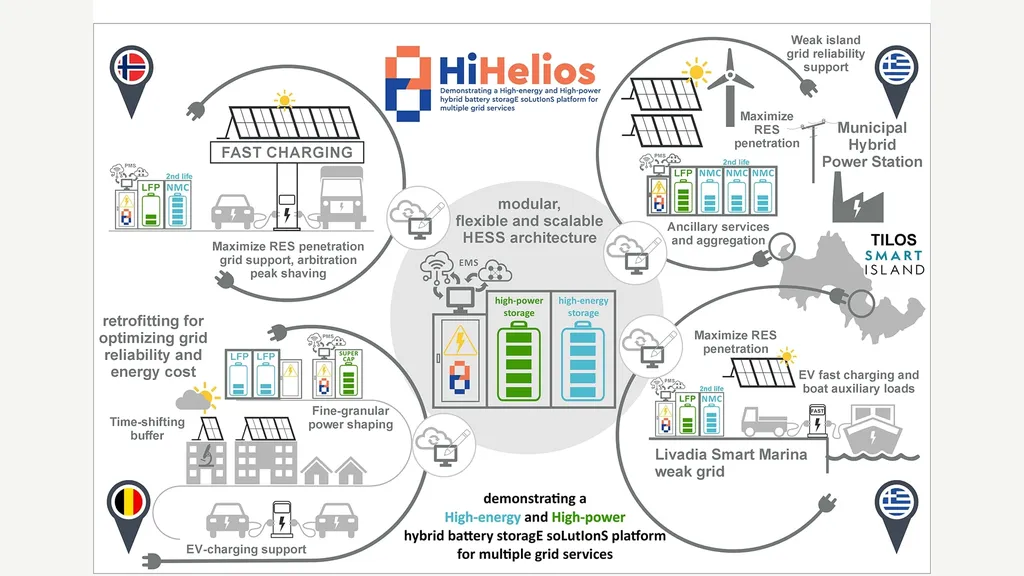
The European Union’s HiHELIOS project is tackling a critical challenge in the renewable energy sector: the need for flexible, high-performance energy storage systems that can integrate seamlessly with an increasingly green grid. As Europe transitions towards climate neutrality, the intermittent nature of wind and solar power demands innovative solutions to balance electricity supply and demand. HiHELIOS is rising to this challenge by developing a modular hybrid battery system that combines the best of high-energy and high-power storage technologies.
The project’s core innovation lies in its hybrid design, which merges second-life Nickel Manganese Cobalt (NMC) battery modules from electric vehicles (EVs) with either Lithium Iron Phosphate (LFP) batteries or supercapacitors. This combination targets long-duration storage, an impressive lifespan of over 5,000 cycles, and a levelised cost of storage (LCOS) below 0.05 €/kWh by 2030. “The power of hybridisation is that it allows us to optimise performance, lifetime, and cost-effectiveness far beyond conventional single-chemistry systems,” explains a HiHELIOS spokesperson.
To ensure the high-energy and high-power systems work in synergy, HiHELIOS is developing an advanced, multi-layered control architecture. This hierarchical system includes an Energy Management System (EMS) for strategic planning, a Power Management System (PMS) for real-time actions, and a Battery Management System (BMS) for monitoring and maintaining battery health. This intelligent framework will be enhanced by advanced battery models and ‘digital twins’ for real-time diagnostics and predictive maintenance.
The versatility of the HiHELIOS system is being demonstrated through four diverse use cases across Europe. In Norway, the system will support EV fast-charging stations, managing power peaks and storing excess local solar production. In Belgium, it will optimise energy community management with EV charging, solar power integration, and grid support. In Greece, two demonstrators will be deployed on the island of Tilos, supporting a smart marina’s microgrid and providing critical stability services to the island’s weak power system.
HiHELIOS is not just a research project; it is a direct pathway to commercialisation. The project aims to deliver four fully operational demonstrators at Technology Readiness Level (TRL) 7 by its conclusion. These systems will continue to operate, providing long-term validation of their performance and economic viability. With 12 partners from six countries, HiHELIOS is well-positioned to transition from R&D to market application.
The development of such advanced hybrid energy storage systems could significantly accelerate the integration of renewable energy sources into the grid. By providing a cost-effective, flexible, and reliable storage solution, HiHELIOS has the potential to enhance grid stability, support the growth of EV infrastructure, and contribute to Europe’s climate neutrality goals. As the project moves forward, it will be crucial to monitor its progress and the real-world impact of its technology. The energy sector is watching closely, as the success of HiHELIOS could pave the way for a new era of smart, sustainable energy storage.