
In the realm of low-energy particle detection, a team of researchers from various institutions, including the University of Coimbra, the University of Rome Tor Vergata, and the University of Liverpool, have been exploring the potential of Time Projection Chambers (TPCs) equipped with Gas Electron Multipliers (GEMs) and optical readout by scientific CMOS cameras. Their work is part of the CYGNO experiment, which aims to detect low-energy particles with high precision.
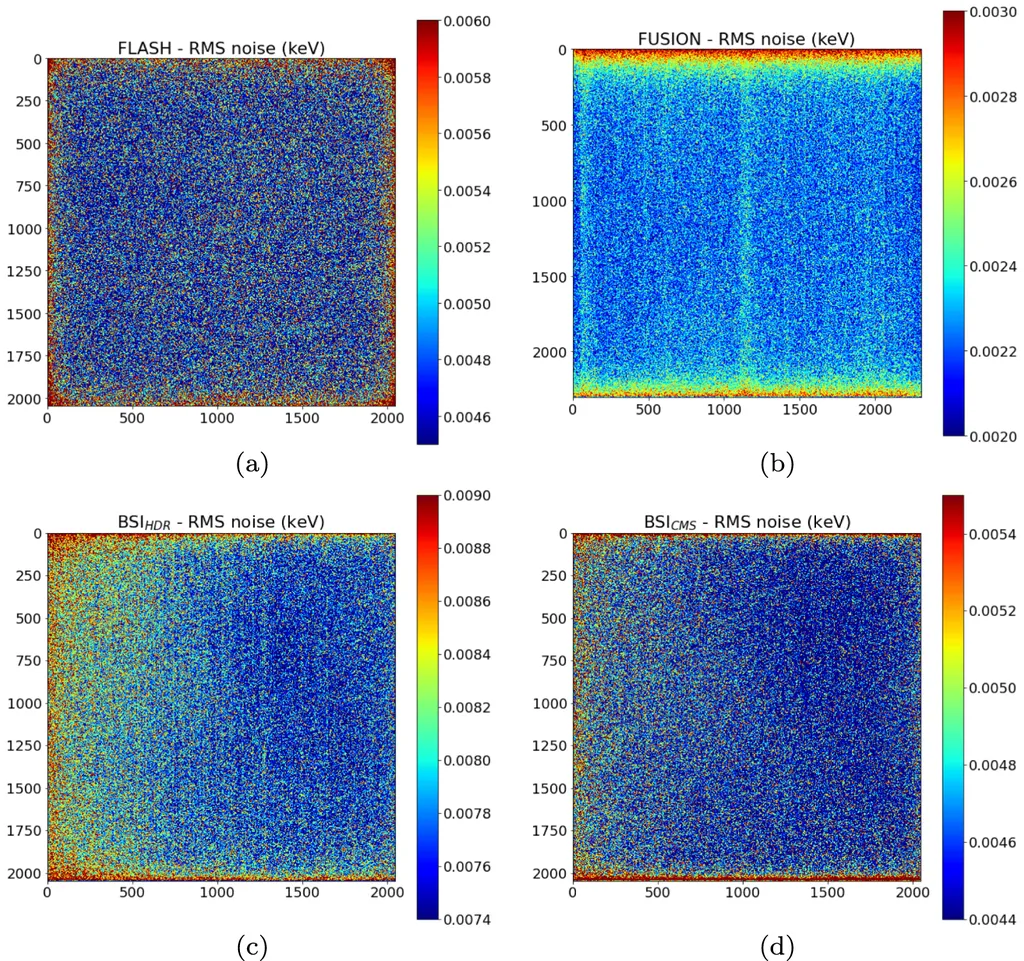
The researchers have conducted a detailed characterization of two state-of-the-art scientific CMOS sensors, focusing on their dark-signal behavior across different exposure times and their detection sensitivity. To assess the latter, they used the well-defined X-ray emissions from a 55Fe source, which mimic the low-light conditions expected in the CYGNO experiment.
CYGNO currently employs a very low-noise Hamamatsu sensor, the ORCA-Fusion, for testing and validation of its detection system. Hamamatsu has recently introduced two new sensors that could be of interest for future upgrades. The first is an improved version of the current model, the ORCA-Fusion-BT, featuring a back-illuminated design that reaches a quantum efficiency of up to 95% at 550 nm. The second is a next-generation sensor, the ORCA-Quest. Although its peak quantum efficiency is not as high as that of the Fusion-BT, it offers high sensitivity over a broader spectral range, extending into the ultraviolet region, and provides ultra-low readout noise of 0.27 electrons, about 2.6 times lower than that of the Fusion family.
The researchers found that these two sensors represent a significant opportunity to enhance the performance of scientific experiments, including those conducted by the CYGNO collaboration. Their comprehensive characterization of these sensors evaluated their relevance for experiments operating in photon-limited environments and their suitability for integration into the CYGNO detector system.
The practical applications of this research for the energy sector could be significant. Improved low-energy particle detection could enhance safety and monitoring in nuclear power plants, as well as improve the efficiency and accuracy of radiation therapy in the medical field. Moreover, the broader spectral sensitivity of the ORCA-Quest could be beneficial in applications such as remote sensing and environmental monitoring, where detecting a wide range of wavelengths is crucial.
This research was published in the Journal of Instrumentation, a peer-reviewed open-access journal covering topics in particle and nuclear physics, accelerator science, and instrumentation.
This article is based on research available at arXiv.