
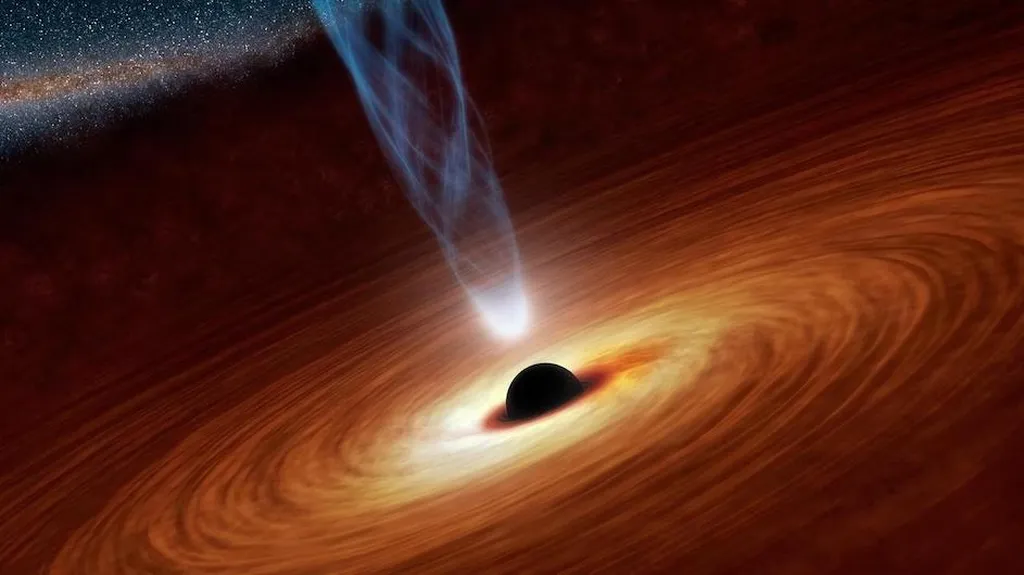
In the realm of energy journalism, it’s crucial to stay updated with the latest scientific research, especially when it comes to understanding the complex phenomena surrounding energy sources. A team of researchers from Columbia University, including A. Hankla, A. Philippov, R. Mbarek, R. Mushotzky, G. Musoke, D. Grošelj, and M. Liska, has been delving into the mysteries of radio-quiet active galactic nuclei (RQAGN), a type of energy source that has puzzled scientists for years.
The team’s recent study, published in the journal Nature Astronomy, sheds light on the origin of millimeter emission from RQAGN. This emission, observed within parsec scales of the central black hole, has been a subject of intrigue due to its unknown origin. The researchers propose a model that suggests the millimeter emission comes from a spatially extended region magnetically connected to the compact X-ray corona, similar to the relationship between the solar wind and the sun’s corona.
The model presented by the researchers is an analytic one, scaled to corona values. It posits that non-equipartition electrons from multiple heights along an extended conical outflow shape the millimeter emission. According to this model, the 100 GHz emission originates from within a region of about 10,000 gravitational radii of the central black hole, though the projected distance can be as low as 50 gravitational radii, depending on the line-of-sight.
The model predicts a flat emission spectrum and a millimeter-to-X-ray luminosity ratio consistent with observations. These quantities depend weakly on the underlying electron power-law distribution function and black hole mass. The researchers also demonstrated the plausibility of their model using a general relativistic magneto-hydrodynamic (GRMHD) simulation of a thin accretion disc as a case study.
The practical applications of this research for the energy sector are not immediately apparent, as RQAGN are not currently harnessed as an energy source. However, understanding the fundamental physics of these objects can contribute to our broader knowledge of black holes and their environments, which could have implications for future energy technologies. Moreover, the study highlights the need for further research into continual dissipation along the outflow to connect the X-ray- and millimeter-emitting regions, which could lead to new insights and potential applications in the field of energy.
In conclusion, the research conducted by the team from Columbia University provides a significant step forward in our understanding of RQAGN and their millimeter emission. While the practical applications for the energy sector may not be immediate, the study underscores the importance of fundamental research in advancing our knowledge of the universe and its potential energy sources.
This article is based on research available at arXiv.