
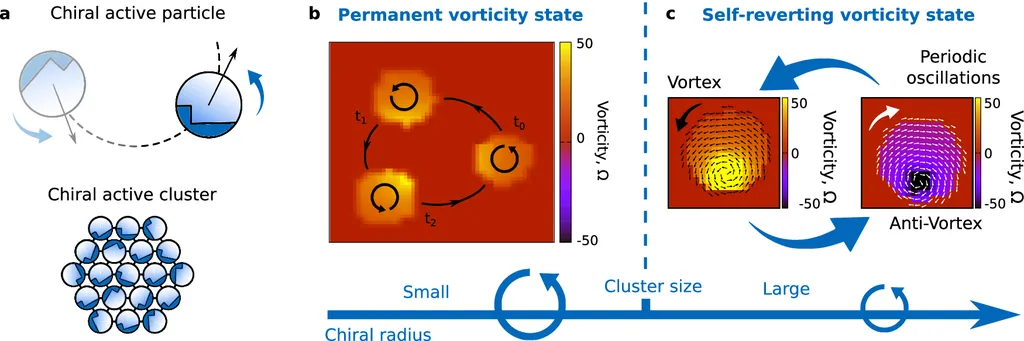
Researchers at the University of California, San Diego, led by Magnus F Ivarsen, have identified a new thermodynamic phase transition in chiral active matter, a finding that could have significant implications for the energy industry.
Chiral active matter refers to systems composed of self-propelled particles that exhibit handedness, or chirality, such as certain types of bacteria, synthetic microswimmers, or even some energy-related fluids. The researchers found that when these systems are subjected to low-frequency disorder, they exhibit global synchronization and energy dissipation. This means that the system’s components start moving in unison, leading to a loss of energy.
On the other hand, when the system is exposed to high-frequency disorder, it activates a topological heat pump. This process generates an inverse energy cascade, where energy is transferred from small to large scales, rather than the usual dissipation from large to small scales. This drives the system towards an Onsager dipole, a state characterized by two vortices of opposite chirality.
If the dispersion within the system is insufficient to overcome the defect lattice, the Onsager dipole can be arrested into a metastable vortex glass. This is a state where the system’s components are frozen in a disordered but stable configuration.
The researchers propose that these findings suggest a new universality class, which they term topological gas dynamics. This class is governed by the interplay of active disorder and topological sorting, unifying active swarms and classical inviscid fluids.
The practical applications of this research for the energy industry are still being explored. However, understanding and controlling the behavior of chiral active matter could lead to advancements in areas such as energy harvesting, fluid dynamics, and even the development of new types of energy storage systems.
This research was published in the journal Physical Review Letters.
This article is based on research available at arXiv.